
ON · Grade 10 · Science · SNC2D
SNC2D Science, Grade 10: practice exam, exam review and practice tests
Every SNC2D unit, practised the way it is tested: a worksheet for each topic in the order of the Ontario curriculum, with Core / Applied / Extension questions and full worked solutions, a timed practice test after every two or three topics, and a complete final exam with new questions for exam review.
- 8 topics
- 8 homework sets
- 124 questions
- 3 stage quizzes
- 1 final exam
- PDF download
One payment, no auto-renewal · access until June 30, 2027 · 7-day refund if nothing has been downloaded · secure checkout by Stripe

Preview pages
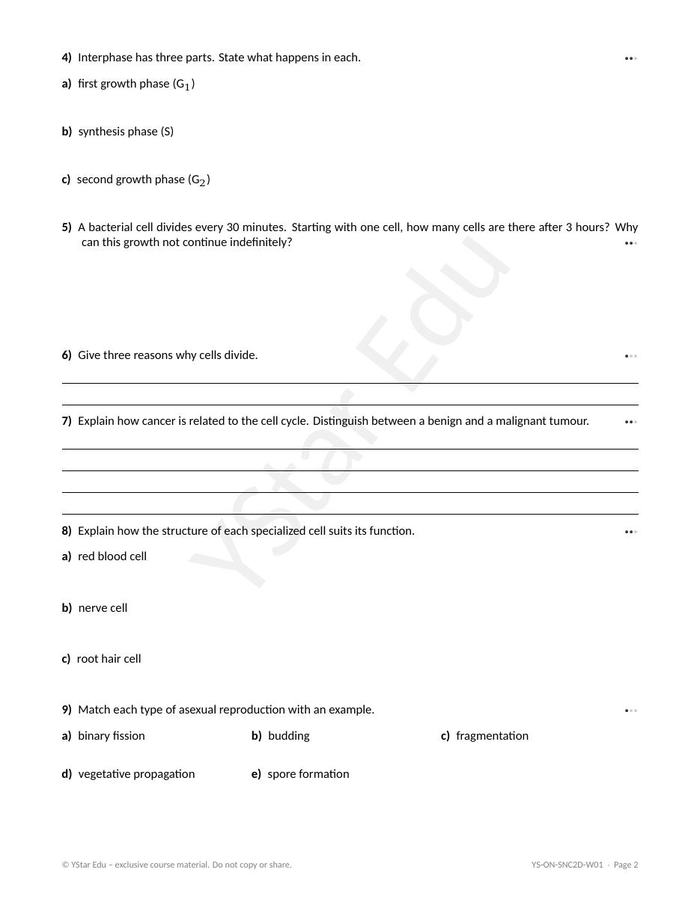
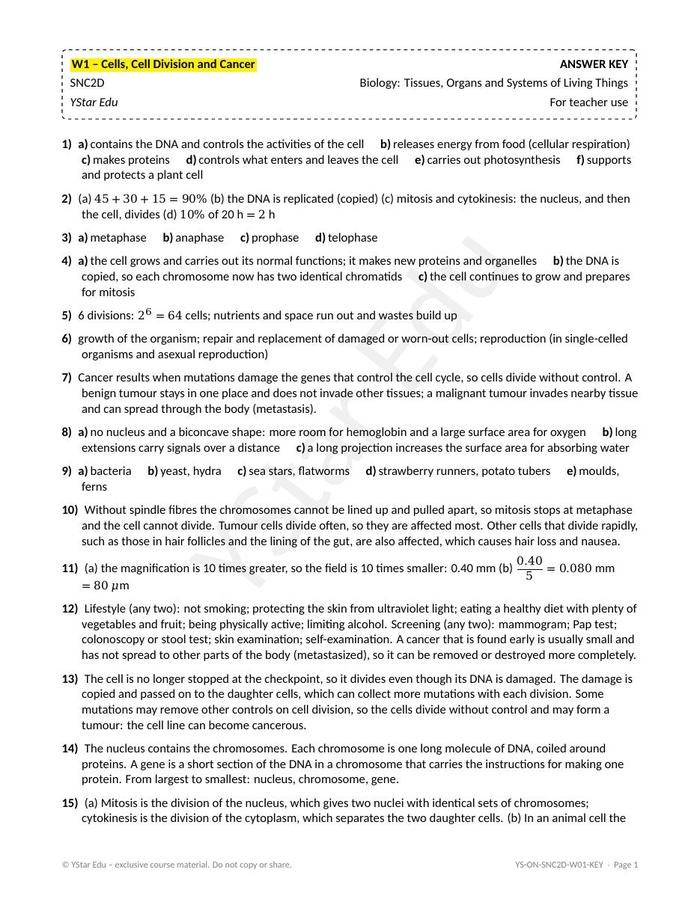
Real pages from this pack: the homework set, its answer key and the final exam. Every set follows this layout.


Topics in this pack
Each topic is a homework set with a separate answer key. Click a topic for details, or buy it on its own for CA$8.
| # | Topic | Questions | Pages | Single topic |
|---|---|---|---|---|
| 1 | Cells, Cell Division and Cancer | 18 | 4 | Buy · CA$8 |
| 2 | Tissues, Organs and Systems | 19 | 5 | Buy · CA$8 |
| 3 | Chemical Compounds: Ions and Formulas | 13 | 3 | Buy · CA$8 |
| 4 | Chemical Reactions | 16 | 5 | Buy · CA$8 |
| 5 | Acids and Bases | 15 | 4 | Buy · CA$8 |
| 6 | Climate Change | 15 | 4 | Buy · CA$8 |
| 7 | Light: Reflection and Mirrors | 14 | 4 | Buy · CA$8 |
| 8 | Refraction and Lenses | 14 | 4 | Buy · CA$8 |
SNC2D practice tests and the practice exam
A timed practice test comes after the biology topics, after the chemistry topics, and after climate change and optics, each with its own answer key, so a unit is checked before the school test rather than after it.
Which practice test goes with which SNC2D unit
Schools number their units differently, so this table goes by unit name. Do the worksheets first, then sit the practice test for that unit with a timer running.
| Unit at school | Worksheets | Timed practice test |
|---|---|---|
| Cells, Tissues and Systems | Topics 1–2 | Quiz 1 · 6 questions · 30 minutes |
| Compounds, Reactions, Acids and Bases | Topics 3–5 | Quiz 2 · 9 questions · 40 minutes |
| Climate Change and Optics | Topics 6–8 | Quiz 3 · 9 questions · 45 minutes |
| Whole course, for exam review | All 8 topics | Practice exam · 75 marks · 120 minutes |
The SNC2D practice exam
- 120 minfinal exam
- 75 marksin 3 parts
- 15 marksPart A, multiple choice
- 32 marksPart B, short answer
- 28 marksPart C, full solutions
Every question on the final counts toward an achievement category (Knowledge, Thinking, Communication or Application), the categories Ontario teachers mark by, and each written question is labelled with its category and marks. A scientific calculator is the only permitted aid, the questions are new rather than repeated from the worksheets, and a separate answer key gives full solutions.
Pacing: 75 marks in 120 minutes is about 1.6 minutes a mark, which works out to roughly 25 minutes for Part A, 50 for Part B and 45 for Part C.
Using the pack for SNC2D exam review: in the last two weeks, practise naming compounds and balancing equations until they are quick, draw a ray diagram for each position of an object in front of a concave mirror and a converging lens, and redo the Spot the Error question at the end of every worksheet. Then sit the final exam in 120 minutes with only a scientific calculator, and mark it with the answer key.
How much is the SNC2D exam worth in 2026–27?
- 65%classroom work
- 20%written final exam
- 15%attendance and participation
From September 2026, Ontario sets the final mark in Grade 9 and 10 courses the same way: 65% classroom work during the course, 20% final evaluation, and 15% attendance and participation. In mathematics, English and science the whole 20% is a written exam. So a fifth of the SNC2D mark now comes from one written paper.
Your teacher can tell you how long the exam is, what format it takes and which aids are allowed.
Source: Ontario Ministry of Education, Growing Success, September 2026 update, read November 13, 2026.
The split between written exam and culminating task for every subject is in how much the final exam is worth in Ontario in 2026–27.
About SNC2D
Science, Grade 10, Academic (SNC2D) is the Ontario course that prepares students for Grade 11 biology, chemistry and physics. Its curriculum has four content strands, Biology: Tissues, Organs and Systems of Living Things; Chemistry: Chemical Reactions; Earth and Space Science: Climate Change; and Physics: Light and Geometric Optics, together with a strand on scientific investigation skills. SNC2D is the prerequisite for SBI3U, SCH3U and SPH3U.
The pack follows the order of the curriculum. Topics 1–2 are biology: cells, the cell cycle and cancer, then tissues, organs and systems in animals and plants. Topics 3–5 are chemistry: naming ionic and molecular compounds, balancing and classifying chemical reactions, and acids and bases. Topic 6 covers climate change, and Topics 7–8 are optics: reflection and mirrors, then refraction and lenses.
What each topic practises
What the questions in each worksheet cover, and the mistake each one warns about, taken from the worksheets themselves.
1Cells, Cell Division and Cancer
Cell structures and their functions, the cell cycle, interphase and the phases of mitosis, cytokinesis in animal and plant cells, why cells divide, cancer and the cell cycle, benign and malignant tumours, specialized cells, asexual reproduction, the field of view of a microscope, cell-cycle checkpoints, the surface area to volume ratio of cells, and newborn screening for phenylketonuria (PKU).
Watch out: thinking that interphase is a resting stage; confusing chromatids with chromosomes.
2Tissues, Organs and Systems
Levels of organization from cell to organ system, animal tissues, the digestive, respiratory and circulatory systems and how they work together, heart rate before and after exercise, plant organs and tissue systems, how water moves up a plant, medical imaging technologies, stem cells and the ethical questions they raise, villi, the thick wall of the left ventricle, and public health measures against influenza.
Watch out: saying that the lungs pump oxygen into the blood; naming an organ when asked for a tissue.
3Chemical Compounds: Ions and Formulas
The ions that elements form from their place in the periodic table, writing formulas and naming ionic compounds, Roman numerals for multivalent metals, polyatomic ions and brackets, prefixes for molecular compounds, classifying elements and ionic and molecular compounds, how calcium chloride forms, and the “dihydrogen monoxide” petition.
Watch out: leaving out the Roman numeral for a multivalent metal; using prefixes to name an ionic compound.
4Chemical Reactions
Balancing skeleton and word equations, synthesis, decomposition, single displacement, double displacement and combustion reactions, the law of conservation of mass, evidence of chemical change, the activity series of metals and of the halogens, the combustion of methane, making lime from limestone, a flameless camping heater, and the principles of green chemistry.
Watch out: changing a subscript instead of a coefficient; counting atoms on only one side.
5Acids and Bases
The pH scale and why each unit is a factor of ten, the properties of acids and bases, naming acids and bases, neutralization reactions, indicators, oxides of metals and non-metals in water, acid precipitation and liming a lake, raising the pH of farm soil, neutralizing an acid spill on a highway, hazard symbols, and scrubbers at coal-burning power plants.
Watch out: thinking a higher pH means a stronger acid; forgetting that each pH unit is a factor of ten.
6Climate Change
Arctic sea ice over time, conduction, convection and radiation, albedo, greenhouse gases and their sources, carbon sources and carbon sinks, positive feedback from thawing permafrost, a family’s carbon emissions, the oceans as a heat sink and rising sea level, the natural and enhanced greenhouse effects, climatographs, global warming potential, evidence of past climates, and the cooling after the eruption of Mount Pinatubo.
Watch out: thinking that a positive feedback loop is a helpful one; confusing a carbon sink with a carbon source.
7Light: Reflection and Mirrors
Sources of light, the electromagnetic spectrum, the laws of reflection, images in plane, concave and convex mirrors described by size, attitude, location and type, ray diagrams, the mirror and magnification equations, regular and diffuse reflection, why AMBULANCE is printed backward, solar cookers and satellite dishes, and fluorescence and phosphorescence.
Watch out: measuring angles from the mirror instead of from the normal; mixing up real and virtual images.
8Refraction and Lenses
The index of refraction and the speed of light in diamond, Snell’s law, total internal reflection and the critical angle, ray diagrams and the thin lens equation for converging and diverging lenses, the parts of the eye, correcting near-sightedness and far-sightedness, dispersion in a prism, optical fibres, rainbows and mirages, and the telescopes of Galileo and Kepler.
Watch out: bending the ray away from the normal when light enters a denser medium; forgetting the sign of the image distance.
A question from the free sample, worked
Spot the Error. A student says: “Mitosis produces cells with half the number of chromosomes of the parent cell.” Find the mistake, explain why it is wrong, and write a correct solution.
Solution. That describes meiosis, which makes sex cells. Mitosis produces two daughter cells with the same number of chromosomes as the parent cell and identical DNA: a human body cell with 46 chromosomes divides into two cells with 46 chromosomes each.
This is question 18 of Topic 1, Cells, Cell Division and Cancer, part of the free sample. Every worksheet in the pack ends with a “Spot the Error” question like this one, because finding someone else's mistake is one of the quickest ways to stop making it.
Where students lose marks in SNC2D
- Interphase is not a resting stage. During interphase the cell grows, copies its DNA and prepares to divide; most of the cell cycle is spent there.
- The lungs do not pump oxygen. Oxygen diffuses from the alveoli into the capillaries, from high concentration to low; the breathing muscles move air, and the heart pumps blood.
- Roman numerals for multivalent metals. FeCl3 is iron(III) chloride, not “iron chloride”, because iron can form Fe2+ or Fe3+.
- No prefixes in ionic names. CaCl2 is calcium chloride, not calcium dichloride; prefixes such as di- and tri- are for molecular compounds, as in CO2, carbon dioxide.
- Balance with coefficients. Count every atom on both sides: 4 Al + 3 O2 → 2 Al2O3. Coefficients that match the subscripts do not make an equation balanced.
- Each pH unit is a factor of ten. A solution with a pH of 2 is 10 × 10 = 100 times as acidic as one with a pH of 4, not twice as acidic.
- A positive feedback loop is not a good thing. “Positive” means the change is amplified: melting ice lowers the albedo, more sunlight is absorbed, and more ice melts.
- Angles are measured from the normal. A ray that strikes a mirror at 30° to its surface has an angle of incidence of 60°.
- Light slows down in glass. Entering a denser medium, light slows down and bends toward the normal; leaving it, light speeds up and bends away from the normal.
Not sure which of these apply? The free diagnostic test shows which topics to start with.
Before and after SNC2D
Before: Science, Grade 9 (SNC1W) is the prerequisite. Its units on atomic and molecular structure and on ecosystems and climate change lead straight into the chemistry and climate-change units of SNC2D.
After: SNC2D is the prerequisite for Grade 11 Biology (SBI3U), Chemistry (SCH3U) and Physics (SPH3U): cells and organ systems lead into SBI3U, compounds and reactions into SCH3U, and the equations and ray diagrams of optics into the problem solving of SPH3U.
Questions parents ask
Is there a free SNC2D practice test?
Yes. Quiz 1 is a free timed practice test with its own answer key, a PDF with no sign-in. Topic 1’s complete worksheet and answer key are free in the same way, and so is the online diagnostic test, which takes 30 to 45 minutes and reports the result topic by topic. The other 2 timed practice tests and the practice exam come with the full pack.
Does the SNC2D practice exam come with answers?
Yes. The practice exam has a complete answer key, and every worksheet and practice test in the pack has its own answer key too.
How much is the SNC2D final exam worth?
In the 2026–27 school year the written exam is 20% of the final mark in Grade 10 mathematics, English and science courses. Classroom work is 65% and attendance and participation 15%, under Ontario’s updated Growing Success policy.
How long is the SNC2D exam?
Each school sets the length of its own exam, so ask your teacher. The practice exam in this pack is 120 minutes for 75 marks.
What is in the SNC2D practice pack?
8 homework sets (one per topic, 124 questions in Core, Applied and Extension tiers) with full worked answer keys, 3 timed stage quizzes and a final exam, all as PDFs you can print or use on a tablet.
How long do I have access?
Until June 30, 2027, the end of the 2026–27 school year. It is a one-time payment and does not renew.
Can I buy a single topic?
Yes. Each topic below is sold on its own for CA$8 (homework set and answer key). The quizzes and the final exam come with the full pack.
Can I see a sample first?
Yes. The first topic's complete homework set and answer key can be downloaded free, without signing in, from the course page in the store.
Does the pack cover all four units of SNC2D?
Yes. Topics 1–2 cover biology, Topics 3–5 chemistry, Topic 6 climate change, and Topics 7–8 light and geometric optics, with a practice test after each group of topics.
Can I use the pack for SNC2D exam review?
Yes. The three practice tests check every unit, and the final exam is a full 120-minute paper with new questions, 75 marks across multiple choice, short answer and full solutions, with a complete answer key.
Which Grade 11 science courses need SNC2D?
SNC2D is the prerequisite for Grade 11 Biology (SBI3U), Chemistry (SCH3U) and Physics (SPH3U), the university-preparation science courses.
Get the SNC2D practice pack
8 worksheets with worked answers, 3 timed practice tests and a practice exam, as printable PDFs. Start with the free sample: the first topic’s complete worksheet and answer key.
One payment, no auto-renewal · access until June 30, 2027 · 7-day refund if nothing has been downloaded · secure checkout by Stripe
Other Ontario courses
- Biology, Grade 11 (SBI3U) Grade 11 · Biology
- Biology, Grade 12 (SBI4U) Grade 12 · Biology
- Chemistry, Grade 11 (SCH3U) Grade 11 · Chemistry
- Chemistry, Grade 12 (SCH4U) Grade 12 · Chemistry
- English, Grade 9 (ENL1W) Grade 9 · English
- English, Grade 10 (ENG2D) Grade 10 · English
- English, Grade 11 (ENG3U) Grade 11 · English
- English, Grade 12 (ENG4U) Grade 12 · English
- Mathematics, Grade 9 (MTH1W) Grade 9 · Math
- Principles of Mathematics, Grade 10 (MPM2D) Grade 10 · Math
- Functions, Grade 11 (MCR3U) Grade 11 · Math
- Calculus and Vectors, Grade 12 (MCV4U) Grade 12 · Math
- Data Management, Grade 12 (MDM4U) Grade 12 · Math
- Advanced Functions, Grade 12 (MHF4U) Grade 12 · Math
- Physics, Grade 11 (SPH3U) Grade 11 · Physics
- Physics, Grade 12 (SPH4U) Grade 12 · Physics
- Science, Grade 9 (SNC1W) Grade 9 · Science
All-access: every course pack for one payment, until June 30, 2027.