
ON · Grade 11 · English · ENG3U
ENG3U English, Grade 11: practice exam, exam review and practice tests
Every ENG3U unit, practised the way it is tested: a worksheet for each topic, with Core / Applied / Extension questions and model answers, original passages, poems and speeches to analyse, a timed practice test after every two topics, and a complete final exam for exam review.
- 10 topics
- 10 homework sets
- 61 questions
- 5 stage quizzes
- 1 final exam
- PDF download
One payment, no auto-renewal · access until June 30, 2027 · 7-day refund if nothing has been downloaded · secure checkout by Stripe

Preview pages
Real pages from this pack: the homework set, its answer key and the final exam. Every set follows this layout.


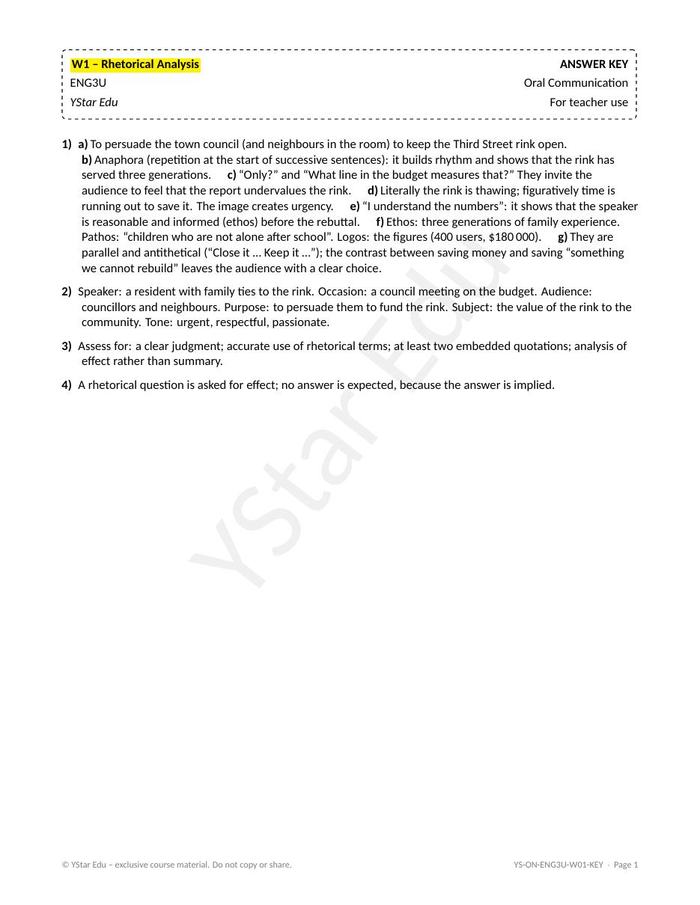

Topics in this pack
Each topic is a homework set with a separate answer key. Click a topic for details, or buy it on its own for CA$8.
ENG3U practice tests and the practice exam
A timed practice test comes after every two topics, each with model answers, so a unit is checked before the school test rather than after it.
Which practice test goes with which ENG3U unit
Schools number their units differently, so this table goes by unit name. Do the worksheets first, then sit the practice test for that unit with a timer running.
| Unit at school | Worksheets | Timed practice test |
|---|---|---|
| Rhetoric and Narrative Voice | Topics 1–2 | Quiz 1 · 4 questions · 25 minutes |
| Poetry and Tragedy | Topics 3–4 | Quiz 2 · 4 questions · 25 minutes |
| Style and the Analytical Essay | Topics 5–6 | Quiz 3 · 4 questions · 20 minutes |
| Comparing Texts and Satire | Topics 7–8 | Quiz 4 · 4 questions · 25 minutes |
| Argument and Synthesis | Topics 9–10 | Quiz 5 · 4 questions · 25 minutes |
| Whole course, for exam review | All 10 topics | Practice exam · 69 marks · 120 minutes |
The ENG3U practice exam
- 120 minfinal exam
- 69 marksin 3 parts
- 14 marksPart A, multiple choice
- 30 marksPart B, short answers on an unseen personal essay
- 25 marksPart C, an analytical paragraph and a persuasive essay
Every question on the final counts toward an achievement category (Knowledge, Thinking, Communication or Application), the categories Ontario teachers mark by, and each written question is labelled with its category and marks. No aids are permitted, the essay to analyse is new, and a separate answer key gives model answers.
Pacing: 69 marks in 120 minutes is about 1.7 minutes a mark, which works out to roughly 25 minutes for Part A, 50 for Part B and 45 for Part C.
A three-week ENG3U exam review plan
| When | What to do |
|---|---|
| Three weeks before the exam | Sit the five practice tests again, one a day, with a timer. Compare your answers with the model answers and list the skills where marks were lost. |
| Two weeks before | Revise the key terms of each topic until you can define each one and give an example. Then write an analytical paragraph and plan a persuasive essay against the clock and compare them with the model answers. |
| The last week | Sit the practice exam in one 120-minute sitting: an unseen personal essay to analyse, an analytical paragraph and a persuasive essay. Mark it with the model answers and sort the lost marks by part and by category. |
| The last two days | Rewrite your weakest paragraph from the practice exam, then reread the model answers without writing. |
How much is the ENG3U exam worth in 2026–27?
- 65%classroom work
- 25%written final exam
- 10%attendance and participation
From September 2026, Ontario sets the final mark in Grade 11 and 12 courses the same way: 65% classroom work during the course, 25% final evaluation, and 10% attendance and participation. In mathematics, English and science the whole 25% is a written exam. So a quarter of the ENG3U mark now comes from one written paper.
Your teacher can tell you how long the exam is, what format it takes and which aids are allowed.
Source: Ontario Ministry of Education, Growing Success, September 2026 update, read November 13, 2026.
The split between written exam and culminating task for every subject is in how much the final exam is worth in Ontario in 2026–27.
Free ENG3U practice questions with model answers
Seven questions from across the course. Try each one before opening the model answer. Question 1 is from the pack’s free sample; questions 2 to 7 were written for this page in the same style, and every passage in them is original.
1. Rhetorical analysis · Spot the Error. A student says: “A rhetorical question is a question that the speaker expects the audience to answer aloud.” Find the mistake, explain why it is wrong, and write a correct solution.
Show the model answer
A rhetorical question is asked for effect: no answer is expected, because the answer is implied. A speaker who asks “Is this the town we want to leave to our children?” is not waiting for a reply; the question leads the audience to the answer the speaker wants.
2. Narrative voice. “I told everyone I wasn’t nervous about the audition, but my hands kept finding the edge of the table.” Identify the point of view, and explain what the second half of the sentence shows that the narrator does not say directly.
Show the model answer
The passage is in the first person (“I”). The narrator claims not to be nervous, but the physical detail of the hands gripping the table shows the opposite. The writer is showing rather than telling: the reader sees the nervousness through action and can tell that the narrator is not being fully honest, with others or with herself.
3. Poetry: form, sound and meaning. “The silent sea slid softly past the stones.” Name the sound device and explain its effect.
Show the model answer
The repeated “s” sounds at the start of “silent”, “sea”, “slid” and “softly” are alliteration, and the hissing “s” throughout the line is sibilance. The soft, repeated sound imitates the quiet movement of the water and creates a calm, hushed mood that matches the meaning of the line.
4. Satire and irony · Spot the Error. A student writes: “Dramatic irony is when a character says the opposite of what they mean.” Find the mistake and write a correct definition with an example.
Show the model answer
That is the definition of verbal irony. Dramatic irony is when the audience knows something that a character does not. For example, if the audience has seen a character hide a letter in a drawer, the scene in which another character searches the whole house for it, and says “It must be lost for good,” is dramatic irony: the audience knows where the letter is.
5. Sentence craft and style. Correct the comma splice in two different ways: “The bus was late, we missed the first period.”
Show the model answer
A comma splice joins two complete sentences with only a comma. Two correct versions: “The bus was late; we missed the first period.” (a semicolon joins two closely related sentences) and “Because the bus was late, we missed the first period.” (a subordinate clause shows the cause). A third option is to add a coordinating conjunction: “The bus was late, so we missed the first period.”
6. The analytical essay. In a short story, a girl carries her late grandfather’s stopped watch in her pocket and finally winds it on the last page. A student’s thesis is: “This essay will talk about symbolism in the story.” Explain what is wrong with it and write a stronger thesis.
Show the model answer
The thesis only announces a topic. It makes no arguable claim and does not say what the symbol means or why it matters. A stronger thesis: “The stopped watch symbolizes the narrator’s refusal to move on after her grandfather’s death, and her decision to wind it on the last page shows that grief can be carried forward instead of frozen in place.” It names the symbol, states what it means, and points to the evidence the essay will use.
7. The persuasive essay: argument and counter-argument. Your claim is that high schools should start classes at 9:30 a.m. Write one counter-argument and a rebuttal.
Show the model answer
Counter-argument: “A later start would push sports practices, part-time jobs and family schedules later into the evening, so students might not gain any sleep at all.” Rebuttal: “Schedules can shift with the school day: practices can move earlier on weekends or into lunch periods, and students would still be choosing to wake later rather than staying up later, which is the reason for the change.” A strong rebuttal accepts what is fair in the opposing view and then answers it directly, rather than ignoring it.
The 10 worksheets in the pack have 61 questions in this style, each with a model answer. The free diagnostic test shows which topics to start with.
About ENG3U
English, Grade 11, University Preparation (ENG3U) is the Ontario course that moves students from responding to texts to analysing them and arguing about them in writing. Its curriculum has four strands: Oral Communication; Reading and Literature Studies; Writing; and Media Studies. ENG3U is the prerequisite for Grade 12 English (ENG4U), which almost every Ontario university program requires.
The pack works through the skills of the course in ten topics. Topics 1–3 are analysis: rhetoric in an original speech, narrative voice, symbolism and theme in a prose passage, and form, sound and meaning in a sonnet. Topic 4 is Shakespearean tragedy, with Macbeth as the main example. Topics 5–6 cover sentence craft and style, then the analytical essay with MLA citation. Topics 7–8 compare texts across genres and study satire and irony, and Topics 9–10 are the persuasive essay and synthesis writing from sources.
What each topic practises
What the questions in each worksheet cover, and the mistake each one warns about, taken from the worksheets themselves.
1Rhetorical Analysis
An original speech delivered at a town council meeting, analysed for anaphora, rhetorical questions, concession, antithesis and appeals to ethos, pathos and logos, a SOAPSTone analysis (speaker, occasion, audience, purpose, subject, tone), and an analytical paragraph on how the speaker balances emotional and logical appeals.
Watch out: listing devices without explaining their effect on the audience.
2Narrative Voice, Symbolism and Theme
An original prose passage read for narrative voice, symbol, motif, imagery, diction and juxtaposition, identifying techniques and what they suggest, and stating a theme and showing how the motif of hands and gloves develops it.
Watch out: identifying a symbol without explaining what it represents; summarizing instead of analysing.
3Poetry: Form, Sound and Meaning
An original sonnet, “Commute”, read for its quatrains, volta, metaphor, sound devices, caesura, enjambment and final couplet, defining each term with an example from the poem, and the Shakespearean sonnet compared with the Petrarchan (Italian) sonnet in structure and rhyme scheme.
Watch out: confusing the Shakespearean and Petrarchan forms; scanning lines by counting words instead of syllables.
4Shakespearean Tragedy
The elements of tragedy (tragic hero, hamartia, hubris, peripeteia, anagnorisis and catharsis), devices in quotations from Macbeth, how Macbeth fits the pattern of the tragic hero, a thesis and outline on how far the hero is responsible for his own downfall, and whether Macbeth is a victim of fate or of his own choices.
Watch out: describing the tragic hero as a villain; retelling the plot instead of analysing the language.
5Sentence Craft and Style
Writing concisely, connotation and denotation, loose and periodic sentences, colons, semicolons and dashes, revising a paragraph for varied sentence structure, a periodic sentence that holds back the main action, commonly confused words, and proofreading for spelling and apostrophes.
Watch out: padding sentences with empty phrases; using the same sentence pattern repeatedly.
6The Analytical Essay
Revising simple theses to be precise and arguable, embedding quotations with ellipses and square brackets, MLA in-text citations and Works Cited entries, counter-argument and rebuttal, planning an analytical essay, introductions and conclusions, adding analysis to evidence, and why a paraphrase still needs a citation.
Watch out: quoting without analysis; leaving a paraphrase uncited.
7Comparing Texts: Theme Across Genres
An original poem and an original prose passage compared for theme, paradox and tone, a comparative paragraph on how both texts show love expressed through objects rather than words, and how the historical context of a poem first published in 1919 shapes its meaning.
Watch out: describing one text and then the other without connecting them.
8Satire and Irony
An original satirical memo, “A Modest Schedule”, analysed for its target, exaggeration, understatement and mock-serious tone, verbal, situational and dramatic irony, satire compared with sarcasm, and writing a satirical paragraph about an unreasonable rule.
Watch out: taking satire literally; confusing satire with sarcasm.
9The Persuasive Essay: Argument and Counter-argument
Claim, evidence and reasoning, ranking evidence by strength, hasty generalization, false cause, appeal to popularity and false dilemma, transitions, a counter-argument and rebuttal on free public transit, planning and introducing a persuasive essay, a paragraph on later school start times, and strengthening weak evidence.
Watch out: leaving out the counter-argument; using opinion as if it were evidence.
10Synthesis: Writing from Sources
Two sources on a four-day school week, signal phrases and citations, summary compared with synthesis, signal verbs such as reports and argues, and a synthesis paragraph that combines both sources around a position.
Watch out: summarizing each source in turn instead of combining them around a point.
Where students lose marks in ENG3U
- Name the device, then explain its effect. “The speaker uses anaphora” earns little on its own; say what the repetition does to the audience and why it matters to the argument.
- Shakespearean or Petrarchan? Both have fourteen lines. A Shakespearean sonnet has three quatrains and a couplet, ABAB CDCD EFEF GG; a Petrarchan sonnet has an octave, ABBAABBA, and a sestet.
- A tragic hero is not a villain. The tragic hero is a person of high standing whose flaw, or hamartia, leads to a downfall that arouses pity and fear.
- Cut empty phrases. “In my own personal opinion, I think that the reason why the poem is sad is because of the fact that…” says no more than “The poem is sad because…”.
- Analyse every quotation. A quotation followed by another quotation is evidence without analysis; explain what each word or image shows.
- Paraphrases need citations too. Changing a few words does not make an idea yours; cite the source in MLA style, for example (Reyes 14).
- Satire is not meant literally. The memo is not really proposing a 5:00 a.m. start; its exaggeration mocks a school system that values worksheets over students’ sleep.
- Address the counter-argument. Acknowledging the other side and rebutting it makes a persuasive essay stronger, not weaker.
- Synthesize, do not summarize. A synthesis paragraph combines the sources around your own point instead of describing Source A and then Source B.
Not sure which of these apply? The free diagnostic test shows which topics to start with.
Before and after ENG3U
Before: English, Grade 10 (ENG2D) is the prerequisite. Clear paragraphs with a topic sentence, evidence and explanation are the starting point for every ENG3U essay.
After: English, Grade 12 (ENG4U) builds on ENG3U: critical lenses, commentaries on unseen poetry and prose, and comparative essays all extend the analysis and essay writing practised here, and ENG4U is required for almost every Ontario university program.
Questions parents ask
Is there a free ENG3U practice test?
Yes. Quiz 1 is a free timed practice test with its own answer key, a PDF with no sign-in. Topic 1’s complete worksheet and answer key are free in the same way, and so is the online diagnostic test, which takes 30 to 45 minutes and reports the result topic by topic. The other 4 timed practice tests and the practice exam come with the full pack.
How much is the ENG3U final exam worth?
In the 2026–27 school year the written exam is 25% of the final mark in Grade 11 mathematics, English and science courses. Classroom work is 65% and attendance and participation 10%, under Ontario’s updated Growing Success policy.
How long is the ENG3U exam?
Each school sets the length of its own exam, so ask your teacher. The practice exam in this pack is 120 minutes for 69 marks.
What is in the ENG3U practice pack?
10 homework sets (one per topic, 61 questions in Core, Applied and Extension tiers) with full worked answer keys, 5 timed stage quizzes and a final exam, all as PDFs you can print or use on a tablet.
How long do I have access?
Until June 30, 2027, the end of the 2026–27 school year. It is a one-time payment and does not renew.
Can I buy a single topic?
Yes. Each topic below is sold on its own for CA$8 (homework set and answer key). The quizzes and the final exam come with the full pack.
Can I see a sample first?
Yes. The first topic's complete homework set and answer key can be downloaded free, without signing in, from the course page in the store.
Which Shakespeare play does the pack use?
Topic 4 uses Macbeth for its quotations and examples, and the questions on the tragic hero can be answered with any Shakespearean tragedy studied in class.
Does the pack teach essay writing?
Yes. Topics 6, 9 and 10 cover the analytical essay, the persuasive essay and synthesis from sources: thesis statements, embedded quotations, MLA citation, counter-arguments and rebuttals, with model answers to compare against.
Can I use the pack for ENG3U exam review?
Yes. The five practice tests each check two topics, and the final exam is a full 120-minute paper, 69 marks across multiple choice, short answers on an unseen personal essay, an analytical paragraph and a persuasive essay, with model answers.
How should I review for the ENG3U exam?
Start three weeks out. Sit the five practice tests again and list the skills where marks were lost, revise the key terms of each topic, write an analytical paragraph and plan a persuasive essay against the clock, then sit the 120-minute practice exam and compare your work with the model answers. The review plan on this page sets it out week by week.
Are there free ENG3U practice questions with model answers?
Yes. This page has seven questions with model answers, and Quiz 1 and Topic 1’s worksheet can be downloaded free with their answer keys, with no sign-in.
Get the ENG3U practice pack
10 worksheets with worked answers, 5 timed practice tests and a practice exam, as printable PDFs. Start with the free sample: the first topic’s complete worksheet and answer key.
One payment, no auto-renewal · access until June 30, 2027 · 7-day refund if nothing has been downloaded · secure checkout by Stripe
Other Ontario courses
- Biology, Grade 11 (SBI3U) Grade 11 · Biology
- Biology, Grade 12 (SBI4U) Grade 12 · Biology
- Chemistry, Grade 11 (SCH3U) Grade 11 · Chemistry
- Chemistry, Grade 12 (SCH4U) Grade 12 · Chemistry
- English, Grade 9 (ENL1W) Grade 9 · English
- English, Grade 10 (ENG2D) Grade 10 · English
- English, Grade 12 (ENG4U) Grade 12 · English
- Mathematics, Grade 9 (MTH1W) Grade 9 · Math
- Principles of Mathematics, Grade 10 (MPM2D) Grade 10 · Math
- Functions, Grade 11 (MCR3U) Grade 11 · Math
- Calculus and Vectors, Grade 12 (MCV4U) Grade 12 · Math
- Data Management, Grade 12 (MDM4U) Grade 12 · Math
- Advanced Functions, Grade 12 (MHF4U) Grade 12 · Math
- Physics, Grade 11 (SPH3U) Grade 11 · Physics
- Physics, Grade 12 (SPH4U) Grade 12 · Physics
- Science, Grade 9 (SNC1W) Grade 9 · Science
- Science, Grade 10 (SNC2D) Grade 10 · Science
All-access: every course pack for one payment, until June 30, 2027.