
ON · Grade 12 · English · ENG4U
ENG4U English, Grade 12: practice exam, exam review and practice tests
Every ENG4U unit, practised the way it is tested: a worksheet for each topic, with Core / Applied / Extension questions and model answers, original passages and poems to analyse, a timed practice test after every two topics, and a complete final exam for exam review.
- 8 topics
- 8 homework sets
- 47 questions
- 4 stage quizzes
- 1 final exam
- PDF download
One payment, no auto-renewal · access until June 30, 2027 · 7-day refund if nothing has been downloaded · secure checkout by Stripe

Preview pages
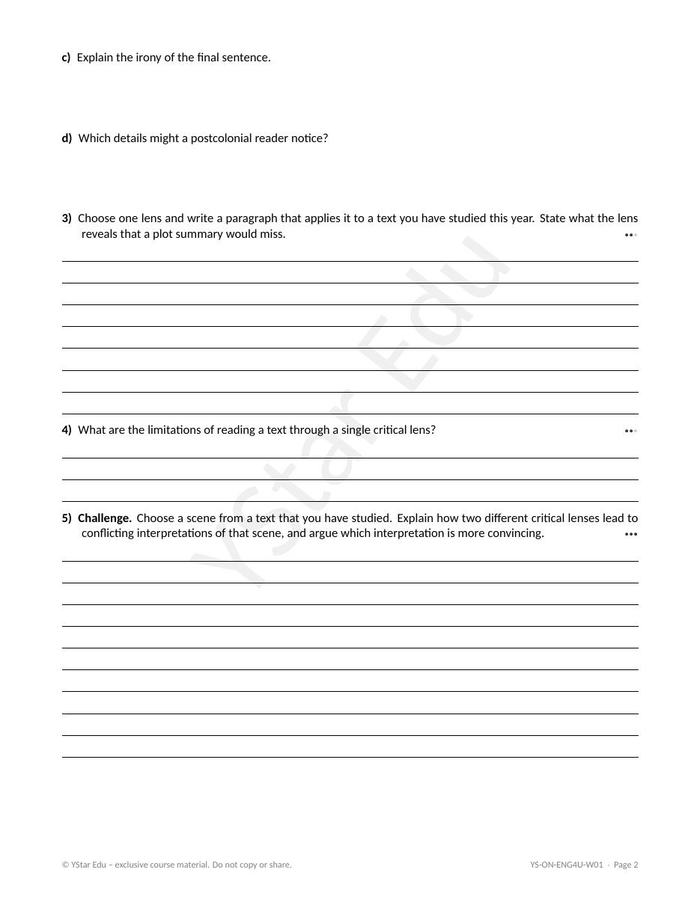
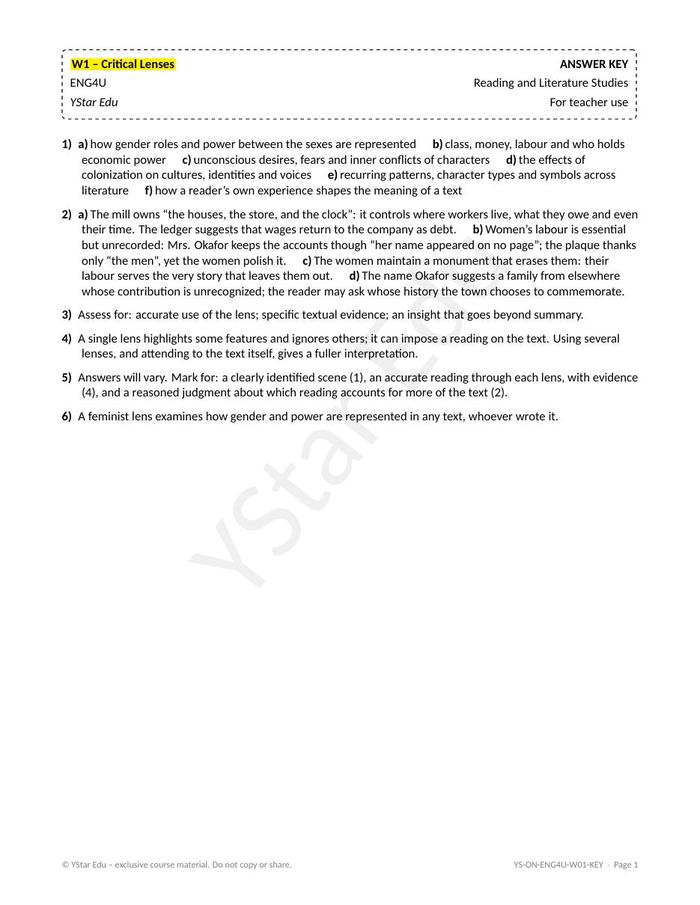
Real pages from this pack: the homework set, its answer key and the final exam. Every set follows this layout.


Topics in this pack
Each topic is a homework set with a separate answer key. Click a topic for details, or buy it on its own for CA$8.
ENG4U practice tests and the practice exam
A timed practice test comes after every two topics, each with model answers, so a unit is checked before the school test rather than after it.
Which practice test goes with which ENG4U unit
Schools number their units differently, so this table goes by unit name. Do the worksheets first, then sit the practice test for that unit with a timer running.
| Unit at school | Worksheets | Timed practice test |
|---|---|---|
| Critical Lenses and Close Reading | Topics 1–2 | Quiz 1 · 4 questions · 25 minutes |
| Poetry and Hamlet | Topics 3–4 | Quiz 2 · 4 questions · 25 minutes |
| Style, Research and Argument | Topics 5–6 | Quiz 3 · 4 questions · 20 minutes |
| Non-fiction and Narrative Technique | Topics 7–8 | Quiz 4 · 4 questions · 25 minutes |
| Whole course, for exam review | All 8 topics | Practice exam · 71 marks · 120 minutes |
The ENG4U practice exam
- 120 minfinal exam
- 71 marksin 3 parts
- 14 marksPart A, multiple choice
- 30 marksPart B, short answers on an unseen passage and poem
- 27 marksPart C, commentary and comparative essay
Every question on the final counts toward an achievement category (Knowledge, Thinking, Communication or Application), the categories Ontario teachers mark by, and each written question is labelled with its category and marks. No aids are permitted, the passage and the poem are new, and a separate answer key gives model answers.
Pacing: 71 marks in 120 minutes is about 1.7 minutes a mark, which works out to roughly 25 minutes for Part A, 50 for Part B and 45 for Part C.
Using the pack for ENG4U exam review: in the last two weeks, reread your notes on Hamlet, then redo the commentary questions in Topics 2, 3 and 7 against the clock and compare your paragraphs with the model answers. Finally, sit the final exam in 120 minutes: an unseen passage, an unseen poem and a comparative essay are exactly what ENG4U exams ask for.
How much is the ENG4U exam worth in 2026–27?
- 65%classroom work
- 25%written final exam
- 10%attendance and participation
From September 2026, Ontario sets the final mark in Grade 11 and 12 courses the same way: 65% classroom work during the course, 25% final evaluation, and 10% attendance and participation. In mathematics, English and science the whole 25% is a written exam. So a quarter of the ENG4U mark now comes from one written paper.
Your teacher can tell you how long the exam is, what format it takes and which aids are allowed.
Source: Ontario Ministry of Education, Growing Success, September 2026 update, read November 13, 2026.
The split between written exam and culminating task for every subject is in how much the final exam is worth in Ontario in 2026–27.
About ENG4U
English, Grade 12, University Preparation (ENG4U) is the Ontario course that brings together the reading, analysis and writing skills students need for university. Its curriculum has four strands: Oral Communication; Reading and Literature Studies; Writing; and Media Studies. ENG4U is required for admission to almost every Ontario university program, so its final mark usually counts in the admission average.
The pack follows the order many schools teach the course. Topics 1–3 build the tools of literary analysis: critical lenses, close reading of prose and poetry commentary, each with an original passage or poem. Topic 4 is Shakespeare’s Hamlet. Topic 5 covers advanced grammar, style and editing. Topic 6 is comparative essays, research and argument, Topic 7 analyses non-fiction argument and style, and Topic 8 covers narrative technique in modern fiction.
What each topic practises
What the questions in each worksheet cover, and the mistake each one warns about, taken from the worksheets themselves.
1Critical Lenses
Matching feminist, Marxist, postcolonial, archetypal and reader-response criticism to their focus, applying several lenses to an original passage about a mill town, a paragraph applying one lens to a text studied in class, the limits of reading through a single lens, and how two lenses read the same scene differently.
Watch out: forcing a lens onto a text without evidence; treating one reading as the only reading.
2Close Reading of Prose
Close reading of an original prose passage for diction, syntax, imagery, tone and personification, planning a commentary in a technique–effect–meaning chart, and a commentary paragraph on how the writer uses contrast to convey the central idea.
Watch out: paraphrasing the passage instead of analysing how the language works.
3Poetry Commentary
An original poem, “Cartography”, read for speaker, extended metaphor, stanza structure, line breaks, tone shifts and paradox, why the speaker is not necessarily the poet, and a full commentary on how the map-making metaphor develops the theme of identity.
Watch out: assuming the speaker is the poet; commenting only on imagery and ignoring structure.
4Shakespeare: Hamlet
Identifying the speakers of key lines and their significance, the “To be, or not to be” soliloquy, the characters who act as foils to Hamlet, whether Hamlet’s delay is a weakness or a strength, and an argument outline on the claim that his tragedy is that he thinks too much.
Watch out: quoting famous lines without their context; ignoring who is speaking and to whom.
5Advanced Grammar, Style and Editing
Who and whom, the subjunctive mood, restrictive and non-restrictive clauses, dangling modifiers, parallelism, editing a paragraph for grammar, punctuation and style, rewriting nominalized and passive prose in plain language, and revising a paragraph for a confident personal-essay voice.
Watch out: using whom to sound formal where who is required; putting commas around a restrictive clause.
6Comparative Essays, Research and Argument
Naming logical fallacies, block and point-by-point comparative essays, testing comparative theses, paraphrase compared with plagiarism, evaluating sources by currency, authority and purpose, a counter-argument paragraph, and a comparative outline on how two texts present ambition.
Watch out: paraphrasing too closely; describing two texts separately instead of comparing them.
7Analysing Non-fiction: Argument and Style
An original essay analysed for claim, concession, antithesis, metaphor, tone and understatement, its structure paragraph by paragraph, a commentary on how tone and concession make the argument persuasive, types of evidence and appeal and their weaknesses, and the bias of a documentary made by its subject’s own company.
Watch out: summarizing the argument instead of analysing how it is made.
8Narrative Technique in Modern Fiction
Free indirect discourse, the unreliable narrator, dramatic irony, stream of consciousness and point of view in an original story extract, rewriting a paragraph in the first person to see what changes, and a commentary on how the writer creates sympathy for a character while exposing her self-deception.
Watch out: treating a character’s statements as facts; ignoring the gap between what is said and what is meant.
A question from the free sample, worked
Spot the Error. A student says: “A feminist reading can be applied only to texts written by women.” Find the mistake, explain why it is wrong, and write a correct solution.
Solution. A feminist lens examines how gender and power are represented in a text, whoever wrote it. It applies as readily to Hamlet as to a novel by a woman: for example, by asking how Gertrude and Ophelia are spoken about, judged and controlled by the men around them.
This is question 6 of Topic 1, Critical Lenses, part of the free sample. Every worksheet in the pack ends with a “Spot the Error” question like this one, because finding someone else's mistake is one of the quickest ways to stop making it.
Where students lose marks in ENG4U
- Analyse, do not summarize. Say how a technique works and what it does for the meaning, not just what happens in the passage.
- The speaker is not the poet. Write “the speaker”, not “the poet tells us”, unless the poem is clearly autobiographical.
- Embed and explain quotations. A short quotation worked into your sentence and followed by an explanation is evidence; a long quotation left on its own proves nothing.
- Quote Hamlet in context. “To be, or not to be” is about whether to go on living, not about whether to kill Claudius.
- Who or whom? Who is the subject: “Who is responsible?”, not “Whom is responsible?”.
- No commas around a restrictive clause. “Students who finish early may leave” refers only to those students; adding commas changes the meaning.
- A fallacy does not make a conclusion false. It only means that the argument does not prove it.
- Compare, do not list. A comparative essay connects the two texts in every paragraph instead of describing each one separately.
- An unreliable narrator is evidence, not fact. What the narrator claims tells you about the character, not necessarily about what happened.
Not sure which of these apply? The free diagnostic test shows which topics to start with.
Before and after ENG4U
Before: English, Grade 11 (ENG3U) is the prerequisite. Strong thesis statements and paragraphs that embed and explain quotations from Grade 11 are the foundation of every ENG4U assignment.
After: ENG4U is required for admission to nearly every Ontario university program, and the analysis and essay skills it practises are those of first-year university writing courses.
Questions parents ask
Is there a free ENG4U practice test?
Yes. Quiz 1 is a free timed practice test with its own answer key, a PDF with no sign-in. Topic 1’s complete worksheet and answer key are free in the same way, and so is the online diagnostic test, which takes 30 to 45 minutes and reports the result topic by topic. The other 3 timed practice tests and the practice exam come with the full pack.
How much is the ENG4U final exam worth?
In the 2026–27 school year the written exam is 25% of the final mark in Grade 12 mathematics, English and science courses. Classroom work is 65% and attendance and participation 10%, under Ontario’s updated Growing Success policy.
How long is the ENG4U exam?
Each school sets the length of its own exam, so ask your teacher. The practice exam in this pack is 120 minutes for 71 marks.
What is in the ENG4U practice pack?
8 homework sets (one per topic, 47 questions in Core, Applied and Extension tiers) with full worked answer keys, 4 timed stage quizzes and a final exam, all as PDFs you can print or use on a tablet.
How long do I have access?
Until June 30, 2027, the end of the 2026–27 school year. It is a one-time payment and does not renew.
Can I buy a single topic?
Yes. Each topic below is sold on its own for CA$8 (homework set and answer key). The quizzes and the final exam come with the full pack.
Can I see a sample first?
Yes. The first topic's complete homework set and answer key can be downloaded free, without signing in, from the course page in the store.
Which texts does the pack use?
Original passages, poems and essays written for the pack, plus Shakespeare’s Hamlet. Questions about novels or plays studied in class are written so that they work with any text.
Does the pack help with the ENG4U exam?
Yes. The final exam follows the usual format: multiple choice, short answers on an unseen passage and poem, a commentary and a comparative essay, 71 marks in 120 minutes, with model answers.
Is ENG4U required for university?
Yes. ENG4U is required for admission to almost every program at Ontario universities.
Get the ENG4U practice pack
8 worksheets with worked answers, 4 timed practice tests and a practice exam, as printable PDFs. Start with the free sample: the first topic’s complete worksheet and answer key.
One payment, no auto-renewal · access until June 30, 2027 · 7-day refund if nothing has been downloaded · secure checkout by Stripe
Other Ontario courses
- Biology, Grade 11 (SBI3U) Grade 11 · Biology
- Biology, Grade 12 (SBI4U) Grade 12 · Biology
- Chemistry, Grade 11 (SCH3U) Grade 11 · Chemistry
- Chemistry, Grade 12 (SCH4U) Grade 12 · Chemistry
- English, Grade 9 (ENL1W) Grade 9 · English
- English, Grade 10 (ENG2D) Grade 10 · English
- English, Grade 11 (ENG3U) Grade 11 · English
- Mathematics, Grade 9 (MTH1W) Grade 9 · Math
- Principles of Mathematics, Grade 10 (MPM2D) Grade 10 · Math
- Functions, Grade 11 (MCR3U) Grade 11 · Math
- Calculus and Vectors, Grade 12 (MCV4U) Grade 12 · Math
- Data Management, Grade 12 (MDM4U) Grade 12 · Math
- Advanced Functions, Grade 12 (MHF4U) Grade 12 · Math
- Physics, Grade 11 (SPH3U) Grade 11 · Physics
- Physics, Grade 12 (SPH4U) Grade 12 · Physics
- Science, Grade 9 (SNC1W) Grade 9 · Science
- Science, Grade 10 (SNC2D) Grade 10 · Science
All-access: every course pack for one payment, until June 30, 2027.