
ON · Grade 10 · Math · MPM2D
MPM2D Principles of Mathematics, Grade 10: practice exam, exam review and practice tests
Every MPM2D unit, practised the way it is tested: a worksheet for each topic in the order most schools teach it, with Core / Applied / Extension questions and full worked solutions, a timed practice test after every two topics, and a complete final exam with new questions for exam review.
- 10 topics
- 10 homework sets
- 88 questions
- 5 stage quizzes
- 1 final exam
- PDF download
One payment, no auto-renewal · access until June 30, 2027 · 7-day refund if nothing has been downloaded · secure checkout by Stripe

Preview pages
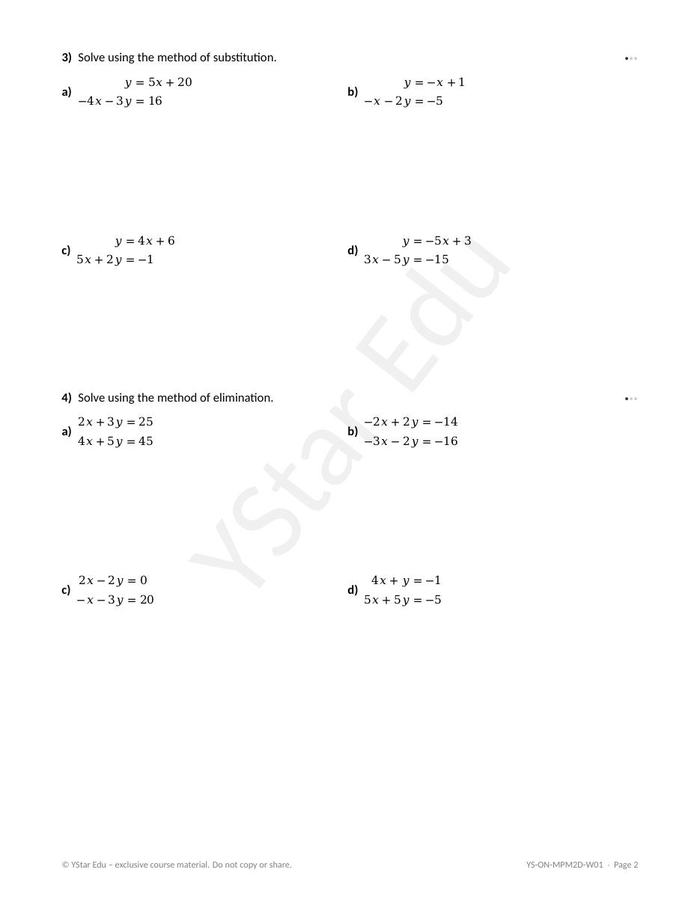
Real pages from this pack: the homework set, its answer key and the final exam. Every set follows this layout.



Topics in this pack
Each topic is a homework set with a separate answer key. Click a topic for details, or buy it on its own for CA$8.
How much is the MPM2D exam worth in 2026–27?
- 65%classroom work
- 20%written final exam
- 15%attendance and participation
From September 2026, Ontario sets the final mark in Grade 9 and 10 courses the same way: 65% classroom work during the course, 20% final evaluation, and 15% attendance and participation. In mathematics, English and science the whole 20% is a written exam. So a fifth of the MPM2D mark now comes from one written paper.
Your teacher can tell you how long the exam is, what format it takes and which aids are allowed.
Source: Ontario Ministry of Education, Growing Success, September 2026 update, read November 13, 2026.
The split between written exam and culminating task for every subject is in how much the final exam is worth in Ontario in 2026–27.
About MPM2D
Principles of Mathematics, Grade 10 (MPM2D) is the Grade 10 academic math course and the prerequisite for Functions, Grade 11 (MCR3U). Its curriculum has three strands: Quadratic Relations of the Form y = ax² + bx + c, Analytic Geometry, and Trigonometry. Most of the algebra that MCR3U expects from the first day, such as expanding, factoring, completing the square and solving quadratic equations, is built here.
This pack follows the usual teaching order. Topics 1–2 cover linear systems and analytic geometry: midpoints, lengths, medians, altitudes, perpendicular bisectors and circles. Topics 3–8 are the quadratic core: expanding and factoring, the key features of a parabola, the three forms of a quadratic, completing the square, solving quadratic equations, and applying them to projectiles, fencing and area problems. Topics 9–10 cover similar triangles, right-triangle trigonometry, and the sine and cosine laws in acute triangles.
What each topic practises
What the questions in each homework set cover, and the mistake each set warns about, taken from the sets themselves.
1Linear Systems
Solving linear systems by graphing, substitution and elimination, stating the number of solutions without solving, and writing systems to model a boat travelling with and against a current, mixing two solutions, and the break-even point for a water-bottle company.
Watch out: sign errors in elimination; not checking the solution in both equations.
2Analytic Geometry
Midpoints and lengths of line segments, medians, altitudes and perpendicular bisectors, deciding whether a point is inside, on or outside the circle x² + y² = r², classifying a quadrilateral from its vertices, a cell tower's 10 km range, and the shortest distance from a point to a line.
Watch out: confusing the midpoint and distance formulas; missing perpendicular slopes.
3Polynomial Products and Common Factoring
Expanding and simplifying binomial and polynomial products, area models, factoring out the greatest common factor, and factoring by grouping.
Watch out: incomplete distribution; not removing the greatest common factor first.
4Factoring Trinomials and Special Products
Factoring x² + bx + c and ax² + bx + c, differences of squares and perfect-square trinomials, factoring fully, an area problem, and finding every integer k for which x² + kx + 12 can be factored.
Watch out: sign pairs with the wrong product or sum; missing the special-product patterns.
5Quadratic Relations: Key Features
Using finite differences to classify relations, the vertex, axis of symmetry, direction of opening, optimal value and y-intercept, transformations of y = x², sketching parabolas, finding a parabola from its vertex and a point, and comparing y = x² with y = 2x.
Watch out: confusing the zeros with the y-intercept; misreading the coordinates of the vertex.
6Quadratic Forms and Completing the Square
Writing quadratics in vertex form by completing the square, reading zeros, axis and vertex from factored form, converting to standard form, and a revenue problem for a store selling phone cases.
Watch out: losing the balancing term; moving horizontally in the wrong direction.
7Solving Quadratic Equations
Solving quadratic equations by factoring, the quadratic formula and completing the square, using the discriminant, and word problems with consecutive integers and the dimensions of a rectangle.
Watch out: not rearranging to zero before factoring; substitution and discriminant errors.
8Quadratic Applications
Applying quadratics to a ball thrown from a building, a pen fenced along a river, a picture frame of uniform width, the path of a soccer ball, and heights read from a graph.
Watch out: keeping roots that make no sense in the context; leaving out units and constraints.
9Similarity and Right-Triangle Trigonometry
Similar triangles and scale factors, a shadow problem, the primary trigonometric ratios for sides and angles, solving right triangles, and angles of elevation and depression.
Watch out: using the wrong reference angle; mixing up the opposite and adjacent sides.
10Sine Law, Cosine Law and Consolidation
The sine law and cosine law in acute triangles, deciding which law to use first, problems with a hot-air balloon and two ships, and a mixed review of the whole course.
Watch out: choosing the wrong law; rounding too early.
A question from the free sample, worked
Spot the Error. To eliminate x from 2x + 3y = 12 and 2x − y = 4, a student subtracts the equations and writes 2y = 8. Find the mistake, explain why it is wrong, and write a correct solution.
Solution. Subtracting −y means adding y: 3y − (−y) = 4y, not 2y. So 4y = 8 and y = 2. Then 2x − 2 = 4 gives x = 3. The solution is (3, 2), and it checks in both equations: 2(3) + 3(2) = 12 and 2(3) − 2 = 4.
This is question 10 of Topic 1, Linear Systems, part of the free sample. Every homework set in the pack ends with a “Spot the Error” question like this one, because finding someone else's mistake is one of the quickest ways to stop making it.
Quizzes and the final exam
A timed stage quiz comes after every two or three topics, each with its own answer key, so a unit is checked before the school test rather than after it.
- After topic 2: Quiz 1: Linear Systems and Analytic Geometry (6 questions)
- After topic 4: Quiz 2: Polynomials and Factoring (6 questions)
- After topic 6: Quiz 3: Quadratic Relations (7 questions)
- After topic 8: Quiz 4: Quadratic Equations and Applications (6 questions)
- After topic 10: Quiz 5: Trigonometry (6 questions)
- 120 minfinal exam
- 30new questions
- 14 marksPart A, multiple choice
- 37 marksPart B, short answer
- 31 marksPart C, full solutions
Every question on the final is labelled with its achievement category (Knowledge, Thinking, Communication or Application), the categories Ontario teachers mark by. A scientific calculator is the only permitted aid, and a separate answer key gives full solutions.
Where students lose marks in MPM2D
- Subtracting a negative in elimination. 3y − (−y) is 4y. Check the final pair in both original equations.
- Squaring a binomial. (x + 3)² = x² + 6x + 9, not x² + 9; the middle term, 2(3)(x), is the one that gets lost.
- Signs when factoring. x² − 5x + 6 = (x − 2)(x − 3): the two numbers must multiply to +6 and add to −5, so both are negative.
- Reading the vertex. The vertex of y = 2(x + 3)² − 5 is (−3, −5), not (3, −5).
- Balancing when completing the square. x² + 6x + 2 = (x² + 6x + 9) − 9 + 2 = (x + 3)² − 7, not (x + 3)² + 2.
- Getting to zero first. x² − 3x = 10 has to become x² − 3x − 10 = 0; then (x − 5)(x + 2) = 0, so x = 5 or x = −2.
- Choosing the law. Use the cosine law when you know two sides and the angle between them, or all three sides; use the sine law when you know a side and the angle opposite it.
Not sure which of these apply? The free diagnostic test shows which topics to start with.
Before and after MPM2D
Before: Mathematics, Grade 9 (MTH1W) builds the linear relations, slopes and algebra that topics 1 and 2 use.
After: Functions, Grade 11 (MCR3U) lists MPM2D as its prerequisite and starts straight away with function notation, completing the square, radicals and the quadratic formula, so topics 3 to 8 here are the ones to be solid on. The trigonometry in topics 9 and 10 continues in MCR3U with angles beyond 90° and the ambiguous case.
Questions parents ask
Is there a free MPM2D practice test?
Yes. Quiz 1 is a free timed practice test with its own answer key, a PDF with no sign-in. Topic 1’s complete worksheet and answer key are free in the same way, and so is the online diagnostic test, which takes 30 to 45 minutes and reports the result topic by topic. The other 4 timed practice tests and the practice exam come with the full pack.
How much is the MPM2D final exam worth?
In the 2026–27 school year the written exam is 20% of the final mark in Grade 10 mathematics, English and science courses. Classroom work is 65% and attendance and participation 15%, under Ontario’s updated Growing Success policy.
What is in the MPM2D practice pack?
10 homework sets (one per topic, 88 questions in Core, Applied and Extension tiers) with full worked answer keys, 5 timed stage quizzes and a final exam, all as PDFs you can print or use on a tablet.
How long do I have access?
Until June 30, 2027, the end of the 2026–27 school year. It is a one-time payment and does not renew.
Can I buy a single topic?
Yes. Each topic below is sold on its own for CA$8 (homework set and answer key). The quizzes and the final exam come with the full pack.
Can I see a sample first?
Yes. The first topic's complete homework set and answer key can be downloaded free, without signing in, from the course page in the store.
Is MPM2D the prerequisite for MCR3U?
Yes. Functions, Grade 11 (MCR3U) lists Principles of Mathematics, Grade 10 (MPM2D) as its prerequisite, and its first unit reuses the factoring and quadratic skills from topics 3 to 8 of this pack.
Which forms of a quadratic does the pack practise?
All three: standard form y = ax² + bx + c, factored form y = a(x − r)(x − s) and vertex form y = a(x − h)² + k, including moving between them by expanding, factoring and completing the square.
Does it cover the sine law and cosine law?
Yes. Topic 10 practises the sine and cosine laws in acute triangles and deciding which to use first, after similar triangles and right-triangle trigonometry in topic 9.
Get the MPM2D practice pack
10 worksheets with worked answers, 5 timed practice tests and a practice exam, as printable PDFs. Start with the free sample: the first topic’s complete worksheet and answer key.
One payment, no auto-renewal · access until June 30, 2027 · 7-day refund if nothing has been downloaded · secure checkout by Stripe
Other Ontario courses
- Biology, Grade 11 (SBI3U) Grade 11 · Biology
- Biology, Grade 12 (SBI4U) Grade 12 · Biology
- Chemistry, Grade 11 (SCH3U) Grade 11 · Chemistry
- Chemistry, Grade 12 (SCH4U) Grade 12 · Chemistry
- English, Grade 9 (ENL1W) Grade 9 · English
- English, Grade 10 (ENG2D) Grade 10 · English
- English, Grade 11 (ENG3U) Grade 11 · English
- English, Grade 12 (ENG4U) Grade 12 · English
- Mathematics, Grade 9 (MTH1W) Grade 9 · Math
- Functions, Grade 11 (MCR3U) Grade 11 · Math
- Calculus and Vectors, Grade 12 (MCV4U) Grade 12 · Math
- Data Management, Grade 12 (MDM4U) Grade 12 · Math
- Advanced Functions, Grade 12 (MHF4U) Grade 12 · Math
- Physics, Grade 11 (SPH3U) Grade 11 · Physics
- Physics, Grade 12 (SPH4U) Grade 12 · Physics
- Science, Grade 9 (SNC1W) Grade 9 · Science
- Science, Grade 10 (SNC2D) Grade 10 · Science
All-access: every course pack for one payment, until June 30, 2027.