
ON · Grade 10 · English · ENG2D
ENG2D English, Grade 10: practice exam, exam review and practice tests
Every ENG2D unit, practised the way it is tested: a worksheet for each topic, with Core / Applied / Extension questions and model answers, original stories, poems and scenes to analyse, a timed practice test after every two or three topics, and a complete final exam for exam review.
- 11 topics
- 11 homework sets
- 74 questions
- 5 stage quizzes
- 1 final exam
- PDF download
One payment, no auto-renewal · access until June 30, 2027 · 7-day refund if nothing has been downloaded · secure checkout by Stripe

Preview pages
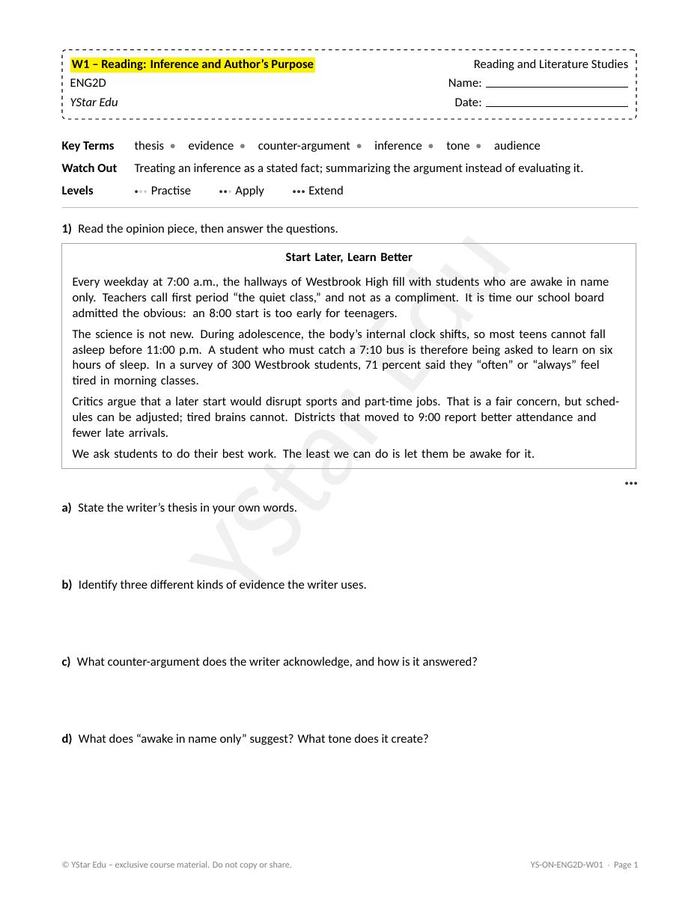
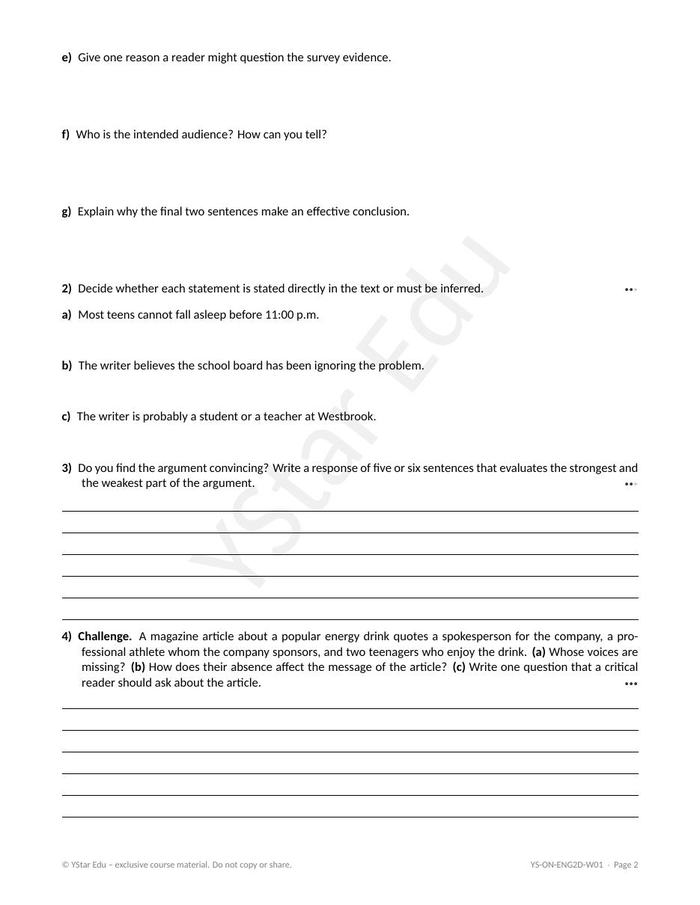
Real pages from this pack: the homework set, its answer key and the final exam. Every set follows this layout.


Topics in this pack
Each topic is a homework set with a separate answer key. Click a topic for details, or buy it on its own for CA$8.
ENG2D practice tests and the practice exam
A timed practice test comes after every two or three topics, each with model answers, so a unit is checked before the school test rather than after it.
Which practice test goes with which ENG2D unit
Schools number their units differently, so this table goes by unit name. Do the worksheets first, then sit the practice test for that unit with a timer running.
| Unit at school | Worksheets | Timed practice test |
|---|---|---|
| Reading and Literary Analysis | Topics 1–2 | Quiz 1 · 4 questions · 25 minutes |
| Poetry and Shakespeare | Topics 3–4 | Quiz 2 · 4 questions · 20 minutes |
| Grammar, Essays and Persuasion | Topics 5–7 | Quiz 3 · 6 questions · 30 minutes |
| Setting and Drama | Topics 8–9 | Quiz 4 · 4 questions · 25 minutes |
| Narrative Writing and Research | Topics 10–11 | Quiz 5 · 4 questions · 20 minutes |
| Whole course, for exam review | All 11 topics | Practice exam · 80 marks · 120 minutes |
The ENG2D practice exam
- 120 minfinal exam
- 80 marksin 3 parts
- 14 marksPart A, multiple choice
- 31 marksPart B, short answers on an unseen opinion piece and poem
- 35 marksPart C, an analytical paragraph, an opinion piece and a news report
Every question on the final counts toward an achievement category (Knowledge, Thinking, Communication or Application), the categories Ontario teachers mark by, and each written question is labelled with its category and marks. No aids are permitted, the texts to analyse are new, and a separate answer key gives model answers.
Pacing: 80 marks in 120 minutes is about 1.5 minutes a mark, which works out to roughly 20 minutes for Part A, 45 for Part B and 55 for Part C.
Using the pack for ENG2D exam review: in the last two weeks, revise the key terms of each topic, then write an analytical paragraph, an opinion piece and a news report against the clock and compare them with the model answers. Finally, sit the final exam in 120 minutes: an unseen opinion piece and poem, then an analytical paragraph, an opinion piece and a news report.
How much is the ENG2D exam worth in 2026–27?
- 65%classroom work
- 20%written final exam
- 15%attendance and participation
From September 2026, Ontario sets the final mark in Grade 9 and 10 courses the same way: 65% classroom work during the course, 20% final evaluation, and 15% attendance and participation. In mathematics, English and science the whole 20% is a written exam. So a fifth of the ENG2D mark now comes from one written paper.
Your teacher can tell you how long the exam is, what format it takes and which aids are allowed.
Source: Ontario Ministry of Education, Growing Success, September 2026 update, read November 13, 2026.
The split between written exam and culminating task for every subject is in how much the final exam is worth in Ontario in 2026–27.
About ENG2D
English, Grade 10, Academic (ENG2D) is the Ontario course that builds the reading, analysis and writing students need for Grade 11 English. Its curriculum has four strands: Oral Communication; Reading and Literature Studies; Writing; and Media Studies. ENG2D is the prerequisite for ENG3U, and Grade 10 is also the year most Ontario students first write the literacy test (OSSLT).
The pack covers the course in eleven topics. Topics 1–3 are reading and analysis: inference and the author’s purpose in an opinion piece, character, conflict and theme in a short story, and tone, mood and figurative language in poetry. Topic 4 is Shakespeare, with Romeo and Juliet as the main example. Topics 5–7 cover grammar and style, the literary essay, and persuasive writing, news reports and opinion pieces. Topics 8–9 study setting, mood and symbolism and the reading of drama, and Topics 10–11 are narrative and descriptive writing and research with MLA citation.
What each topic practises
What the questions in each worksheet cover, and the mistake each one warns about, taken from the worksheets themselves.
1Reading: Inference and Author’s Purpose
An original opinion piece read for thesis, evidence, counter-argument, tone and audience, telling what is stated directly from what must be inferred, evaluating the strongest and weakest parts of the argument, and judging a magazine article that quotes a company spokesperson and an athlete the company sponsors.
Watch out: treating an inference as a stated fact; summarizing the argument instead of evaluating it.
2Literary Analysis: Character, Conflict and Theme
An original short story, “Translation”, whose narrator has interpreted for a grandmother at medical appointments since the age of nine, read for narrator, characterization, internal conflict, irony and symbol, stating its theme in a full sentence with evidence, and direct and indirect characterization.
Watch out: stating a theme as a single word; giving evidence without analysis.
3Poetry: Tone, Mood and Figurative Language
An original free-verse poem read for speaker, tone, mood, imagery and enjambment, why a poet might choose free verse, and stating the theme and choosing the image that expresses it best.
Watch out: confusing tone with mood; assuming that the speaker is the poet.
4Shakespeare: Language and Dramatic Techniques
Elizabethan words and their modern meanings, iambic pentameter in a line from Romeo and Juliet, literary devices in quotations, soliloquy, aside, dramatic irony, foil and tragic flaw, the dramatic irony of the tomb scene, how one character’s decision leads to disaster, and “What’s in a name?” rewritten in modern English.
Watch out: reading Elizabethan words with their modern meanings; confusing a soliloquy with an aside.
5Grammar, Usage and Style
Comma splices, parallel structure, active and passive voice, misplaced and dangling modifiers, punctuation, formal and informal language, subject–verb agreement, and gerunds, participles and infinitives.
Watch out: joining independent clauses with a comma; mixing forms in a list.
6The Literary Essay: Thesis and Body Paragraphs
Strong and weak thesis statements, a thesis with three supporting arguments, introducing and citing “dropped” quotations in MLA style, a Works Cited entry, outlining a body paragraph, recognizing plagiarism, and revising a thesis about Romeo and Juliet that only states a fact.
Watch out: writing a thesis that states a fact; dropping in a quotation without introducing or analysing it.
7Persuasive Writing, News Reports and Opinion Pieces
Ethos, pathos and logos, rhetorical questions, repetition, the rule of three and hyperbole, the inverted pyramid and the five Ws and H, a news report about a food-bank fundraiser, a series of paragraphs giving an opinion on required volunteer hours, the lead of a news story, and how two photographs of the same protest create different impressions.
Watch out: giving an opinion in a news report; stating an opinion without reasons.
8Setting, Mood and Symbolism
An original passage about Elena and an orchard, read for setting, mood, atmosphere, symbol and imagery, a paragraph on how the description of the orchard reflects her feelings, and writing a description that creates a tense mood without naming it.
Watch out: describing a character’s feelings when asked for the mood; naming a symbol without explaining what it stands for.
9Reading Drama: Dialogue and Stage Directions
An original scene between Mara and a clerk, read for stage directions, dialogue, subtext, monologue and conflict, continuing the scene with stage directions, and rewriting it as prose narration to see what is gained and what is lost.
Watch out: ignoring the stage directions; quoting a line without considering how it would be spoken.
10Narrative and Descriptive Writing
Showing instead of telling, sensory detail, punctuating dialogue, precise verbs instead of weak verbs and adverbs, choosing a hook, planning a narrative arc, a descriptive paragraph about an empty place, and one moment written twice to create two different moods.
Watch out: adding intensifiers instead of showing; punctuating dialogue outside the quotation marks.
11Research, Summarizing and Citation
Summarizing and paraphrasing a paragraph from an article, MLA Works Cited entries, judging whether sources on community gardens are reliable, recognizing plagiarism, choosing between a summary, a paraphrase and a direct quotation, and comparing an anonymous 2009 blog post with a Statistics Canada report.
Watch out: changing a few words and calling it a paraphrase; leaving a paraphrase uncited.
A question from the free sample, worked
Spot the Error. A student says: “An inference is a fact that is stated directly in the text.” Find the mistake, explain why it is wrong, and write a correct solution.
Solution. An inference is not stated directly: it is a conclusion the reader reaches by combining clues in the text with reasoning. If a writer says that a character “checked the clock for the fifth time”, the text never says she is impatient; the reader infers it.
This is question 5 of Topic 1, Reading: Inference and Author’s Purpose, part of the free sample. Every worksheet in the pack ends with a “Spot the Error” question like this one, because finding someone else's mistake is one of the quickest ways to stop making it.
Where students lose marks in ENG2D
- A theme is a sentence, not a word. “Love” is a topic; a theme is a full statement about it, such as “Love can be shown more clearly in actions than in words.”
- Tone is not mood. Tone is the writer’s or speaker’s attitude; mood is the feeling the text creates in the reader.
- “Wherefore” means “why”. When Juliet asks “Wherefore art thou Romeo?”, she is asking why he must be Romeo, a Montague, not where he is.
- No comma splices. “I studied all night, I still failed the test” joins two sentences with a comma; use a semicolon, a period, or a word such as “but”.
- A thesis must be arguable. “Macbeth is a play about a Scottish king” is a fact; a thesis makes a claim that the essay sets out to prove.
- Statistics are not pathos. “Nine out of ten dentists recommend this toothpaste” appeals to authority and statistics, ethos and logos; pathos appeals to feelings such as fear or pride.
- Mood is not a character’s feeling. “Elena is sad” describes the character; the mood is the feeling the passage creates in the reader.
- Show, do not intensify. “She was very, very sad” still tells; show the sadness through action, detail or dialogue instead.
- Swapping synonyms is not paraphrasing. A paraphrase uses your own wording and sentence structure, and it still needs a citation, because the idea belongs to the source.
Not sure which of these apply? The free diagnostic test shows which topics to start with.
Before and after ENG2D
Before: ENG2D usually follows Grade 9 English (ENL1W). Reading closely for evidence and writing a clear paragraph with a topic sentence, evidence and explanation are the skills it builds on.
After: English, Grade 11 (ENG3U) builds on ENG2D: rhetorical analysis, the sonnet, Shakespearean tragedy and the analytical and persuasive essay extend the reading and writing practised here.
Also in Grade 10: most students write the Ontario Secondary School Literacy Test for the first time this year. The OSSLT practice tests include a free full-length test with its answer key. See this year’s OSSLT dates and format and how the OSSLT is scored.
Questions parents ask
Is there a free ENG2D practice test?
Yes. Quiz 1 is a free timed practice test with its own answer key, a PDF with no sign-in. Topic 1’s complete worksheet and answer key are free in the same way, and so is the online diagnostic test, which takes 30 to 45 minutes and reports the result topic by topic. The other 4 timed practice tests and the practice exam come with the full pack.
How much is the ENG2D final exam worth?
In the 2026–27 school year the written exam is 20% of the final mark in Grade 10 mathematics, English and science courses. Classroom work is 65% and attendance and participation 15%, under Ontario’s updated Growing Success policy.
How long is the ENG2D exam?
Each school sets the length of its own exam, so ask your teacher. The practice exam in this pack is 120 minutes for 80 marks.
What is in the ENG2D practice pack?
11 homework sets (one per topic, 74 questions in Core, Applied and Extension tiers) with full worked answer keys, 5 timed stage quizzes and a final exam, all as PDFs you can print or use on a tablet.
How long do I have access?
Until June 30, 2027, the end of the 2026–27 school year. It is a one-time payment and does not renew.
Can I buy a single topic?
Yes. Each topic below is sold on its own for CA$8 (homework set and answer key). The quizzes and the final exam come with the full pack.
Can I see a sample first?
Yes. The first topic's complete homework set and answer key can be downloaded free, without signing in, from the course page in the store.
Which Shakespeare play does the pack use?
Topic 4 uses Romeo and Juliet for its quotations and examples, and the questions on dramatic techniques can be answered with any Shakespeare play studied in class.
Does the pack help with the OSSLT?
It is not an OSSLT practice test, but reading opinion pieces and news reports and writing a supported opinion, practised in Topics 1 and 7, are skills the Grade 10 literacy test also uses.
Can I use the pack for ENG2D exam review?
Yes. The five practice tests check every topic, and the final exam is a full 120-minute paper, 80 marks across multiple choice, short answers on an unseen opinion piece and poem, an analytical paragraph, an opinion piece and a news report, with model answers.
Get the ENG2D practice pack
11 worksheets with worked answers, 5 timed practice tests and a practice exam, as printable PDFs. Start with the free sample: the first topic’s complete worksheet and answer key.
One payment, no auto-renewal · access until June 30, 2027 · 7-day refund if nothing has been downloaded · secure checkout by Stripe
Other Ontario courses
- Biology, Grade 11 (SBI3U) Grade 11 · Biology
- Biology, Grade 12 (SBI4U) Grade 12 · Biology
- Chemistry, Grade 11 (SCH3U) Grade 11 · Chemistry
- Chemistry, Grade 12 (SCH4U) Grade 12 · Chemistry
- English, Grade 9 (ENL1W) Grade 9 · English
- English, Grade 11 (ENG3U) Grade 11 · English
- English, Grade 12 (ENG4U) Grade 12 · English
- Mathematics, Grade 9 (MTH1W) Grade 9 · Math
- Principles of Mathematics, Grade 10 (MPM2D) Grade 10 · Math
- Functions, Grade 11 (MCR3U) Grade 11 · Math
- Calculus and Vectors, Grade 12 (MCV4U) Grade 12 · Math
- Data Management, Grade 12 (MDM4U) Grade 12 · Math
- Advanced Functions, Grade 12 (MHF4U) Grade 12 · Math
- Physics, Grade 11 (SPH3U) Grade 11 · Physics
- Physics, Grade 12 (SPH4U) Grade 12 · Physics
- Science, Grade 9 (SNC1W) Grade 9 · Science
- Science, Grade 10 (SNC2D) Grade 10 · Science
All-access: every course pack for one payment, until June 30, 2027.