
BC · Grade 10 · Science · SCIE10
BC Science 10: practice exam, exam review and practice tests
Every Science 10 unit, practised the way it is tested: a worksheet for each topic in the order most BC schools teach it, with Core / Applied / Extension questions and full worked solutions, a timed practice test after every two or three topics, and a complete final exam with new questions for exam review.
- 7 topics
- 7 homework sets
- 78 questions
- 3 stage quizzes
- 1 final exam
- PDF download
One payment, no auto-renewal · access until June 30, 2027 · 7-day refund if nothing has been downloaded · secure checkout by Stripe

Preview pages
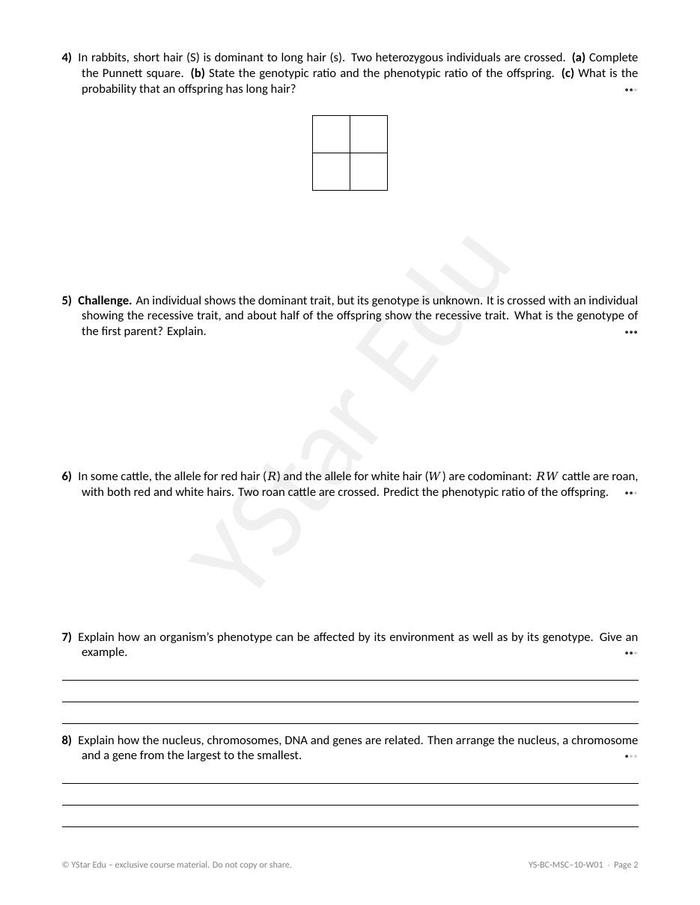
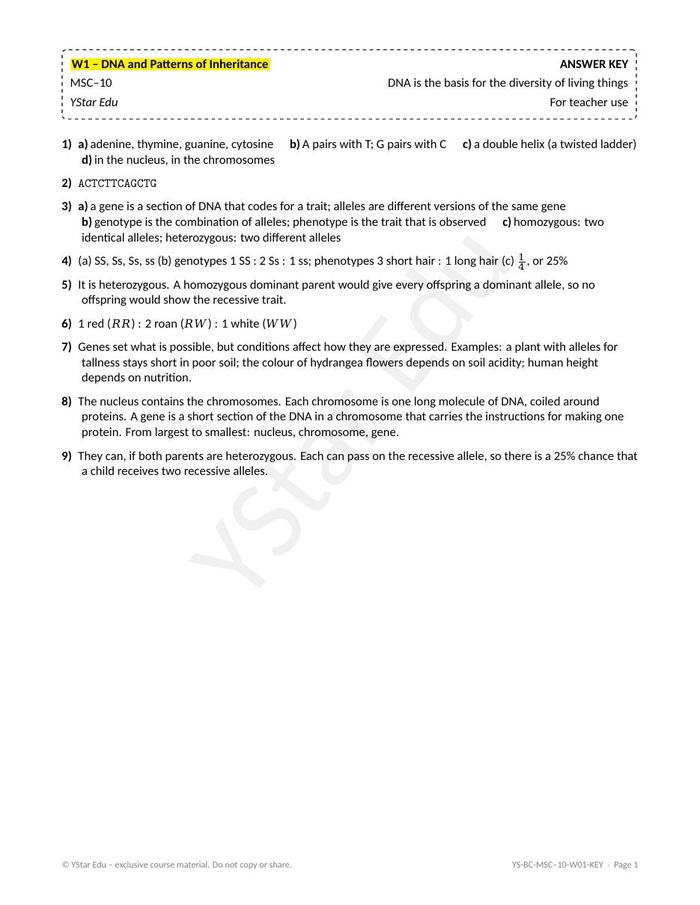
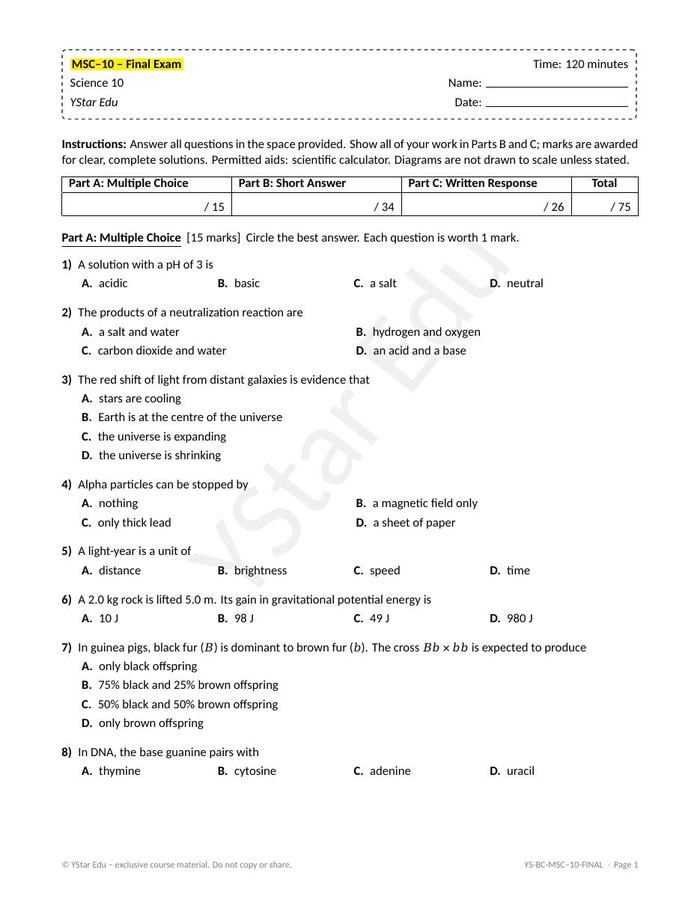
Real pages from this pack: the homework set, its answer key and the final exam. Every set follows this layout.

Topics in this pack
Each topic is a homework set with a separate answer key. Click a topic for details, or buy it on its own for CA$8.
Science 10 practice tests and the practice exam
A timed practice test comes after Topics 2, 4 and 7, each with its own answer key, so a unit is checked before the school test rather than after it.
Which practice test goes with which Science 10 unit
Schools number their units differently, so this table goes by unit name. Do the worksheets first, then sit the practice test for that unit with a timer running.
| Unit at school | Worksheets | Timed practice test |
|---|---|---|
| Genetics | Topics 1–2 | Quiz 1 · 6 questions · 30 minutes |
| Chemical Reactions, Acids and Bases | Topics 3–4 | Quiz 2 · 6 questions · 30 minutes |
| Energy, Radiation and the Universe | Topics 5–7 | Quiz 3 · 9 questions · 45 minutes |
| Whole course, for exam review | All 7 topics | Practice exam · 75 marks · 120 minutes |
The Science 10 practice exam
- 120 minfinal exam
- 75 marksin 3 parts
- 15 marksPart A, multiple choice
- 34 marksPart B, short answer
- 26 marksPart C, written response
Every question on the final shows its marks, and the written-response questions in Part C are marked for complete, well-organized answers, not just the final result. A scientific calculator is the only permitted aid, the questions are new rather than repeated from the worksheets, and a separate answer key gives full solutions.
Pacing: 75 marks in 120 minutes is about 1.6 minutes a mark, which works out to roughly 25 minutes for Part A, 55 for Part B and 40 for Part C.
Using the pack for Science 10 exam review: in the last two weeks, practise Punnett squares, balancing equations and half-life calculations until they are quick, and redo the Spot the Error question at the end of every worksheet. Then sit the final exam in 120 minutes with only a scientific calculator, and mark it with the answer key.
About Science 10
Science 10 is the BC Grade 10 science course that brings together genetics, chemical reactions, energy and the formation of the universe. Like every course in BC’s curriculum, it is built around big ideas, curricular competencies and content; its content covers DNA, inheritance and genetic change, chemical reactions and their energy changes, energy conservation and transformation including nuclear energy, and the big bang theory. It leads to the Grade 11 sciences, among them Life Sciences 11, Chemistry 11 and Physics 11.
The pack follows the order most schools teach the course. Topics 1–2 are genetics: DNA and patterns of inheritance, then mutation, selection and applied genetics. Topics 3–4 are chemistry: chemical reactions and the conservation of mass, then acids, bases and energy changes. Topics 5–6 cover energy conservation and nuclear energy, and Topic 7 the big bang and the universe.
What each topic practises
What the questions in each worksheet cover, and the mistake each one warns about, taken from the worksheets themselves.
1DNA and Patterns of Inheritance
The structure of DNA and complementary base pairing, genes, alleles, genotype and phenotype, a Punnett square for heterozygous rabbits, test crosses, codominance in roan cattle, how the environment affects phenotype, and how the nucleus, chromosomes, DNA and genes are related.
Watch out: confusing genotype with phenotype; assuming that a dominant trait must be the most common one.
2Mutation, Selection and Applied Genetics
Mutations and mutagens, substitutions compared with insertions, antibiotic resistance in bacteria, fur colour in rock pocket mice, natural and artificial selection, the selective breeding of dogs, genetically modified crops, genetic screening and gene therapy, and newborn screening for PKU.
Watch out: saying that organisms mutate because they need to; thinking all mutations are harmful.
3Chemical Reactions and Conservation of Mass
Balancing skeleton and word equations, the types of reaction, the law of conservation of mass, evidence of chemical change, the activity series of metals and of the halogens, the combustion of methane, steel wool heated in open and sealed containers, making lime from limestone, a flameless camping heater, green chemistry and catalysts.
Watch out: changing a subscript instead of a coefficient; counting atoms on only one side.
4Acids, Bases and Energy Changes
The pH scale and why each unit is a factor of ten, the properties, names and formulas of acids and bases, neutralization, exothermic and endothermic changes, energy diagrams and activation energy, acidic and basic oxides, neutralizing an acid spill, an instant cold pack, ionization and dissociation, corrosive products, and scrubbers at power plants.
Watch out: thinking an exothermic reaction needs no energy to start; reading the activation energy from zero.
5Energy Conservation and Transformation
Energy transformations in devices, kinetic and gravitational potential energy, the speed of a diver, the energy lost by a skier, efficiency, why a bouncing ball rises less each time, large-scale energy technologies, and a Sankey diagram for a gasoline car.
Watch out: leaving g out of the potential energy formula; forgetting to square the speed.
6Nuclear Energy and Radiation
Alpha, beta and gamma radiation, nuclear equations, half-life from a graph and by calculation, fission and fusion, the benefits and risks of radiation, a medical isotope, Geiger counters and smoke detectors, and the fission chain reaction in a CANDU reactor.
Watch out: thinking a sample is gone after two half-lives; confusing fission with fusion.
7The Big Bang and the Universe
Astronomical units and light-years, the time light takes to reach Earth, the Hertzsprung–Russell diagram, the life cycle of stars, the evidence for the big bang, Canadian contributions to space exploration, types of galaxies, refracting and reflecting telescopes, and brightness compared with distance.
Watch out: treating a light-year as a unit of time; confusing a solar system with a galaxy.
A question from the free sample, worked
Spot the Error. A student says: “Two parents who both show the dominant trait cannot have a child who shows the recessive trait.” Find the mistake, explain why it is wrong, and write a correct solution.
Solution. Parents who show the dominant trait can still carry the recessive allele. If both are heterozygous (Aa × Aa), each passes on the recessive allele half the time, so each child has a 1/4 chance of being aa and showing the recessive trait.
This is question 9 of Topic 1, DNA and Patterns of Inheritance, part of the free sample. Every worksheet in the pack ends with a “Spot the Error” question like this one, because finding someone else's mistake is one of the quickest ways to stop making it.
Where students lose marks in Science 10
- Genotype is not phenotype. The genotype is the pair of alleles, such as Ss; the phenotype is the trait that shows, such as short hair.
- Dominant does not mean common. A dominant allele hides a recessive one in an individual, but it can still be rare in a population.
- Mutations are random. Bacteria do not mutate because they need to survive; resistant mutants were already present, and the antibiotic killed the others.
- Not all mutations are harmful. Many have no effect, and a few are helpful in a particular environment.
- Balance with coefficients. Count every atom on both sides: 4 Al + 3 O2 → 2 Al2O3.
- Each pH unit is a factor of ten. A solution with a pH of 2 is 100 times as acidic as one with a pH of 4, not twice as acidic.
- Gravitational potential energy needs g. For a 2.0 kg book on a shelf 1.5 m high, Ep = mgh = 2.0 × 9.8 × 1.5 ≈ 29 J, not 2.0 × 1.5 = 3.0 J.
- A sample is not gone after two half-lives. After two half-lives, one quarter of the original sample is still left.
- A light-year is a distance. It is the distance light travels in one year, about 9.5 × 10¹² km.
Not sure which of these apply? The free diagnostic test shows which topics to start with.
Before and after Science 10
Before: Science 9 comes first. Cell division and reproduction lead into genetics, and atoms and compounds into chemical reactions.
After: Science 10 leads to the Grade 11 sciences, including Life Sciences 11, Chemistry 11 and Physics 11, which build on its genetics, chemical reactions and energy.
Questions parents ask
Is there a free Science 10 practice test?
Yes. Quiz 1 is a free timed practice test with its own answer key, a PDF with no sign-in. Topic 1’s complete worksheet and answer key are free in the same way, and so is the online diagnostic test, which takes 30 to 45 minutes and reports the result topic by topic. The other 2 timed practice tests and the practice exam come with the full pack.
Does the Science 10 practice exam come with answers?
Yes. The practice exam has a complete answer key, and every worksheet and practice test in the pack has its own answer key too.
How long is the Science 10 exam?
Each school sets the length of its own exam, so ask your teacher. The practice exam in this pack is 120 minutes for 75 marks.
What is in the SCIE10 practice pack?
7 homework sets (one per topic, 78 questions in Core, Applied and Extension tiers) with full worked answer keys, 3 timed stage quizzes and a final exam, all as PDFs you can print or use on a tablet.
How long do I have access?
Until June 30, 2027, the end of the 2026–27 school year. It is a one-time payment and does not renew.
Can I buy a single topic?
Yes. Each topic below is sold on its own for CA$8 (homework set and answer key). The quizzes and the final exam come with the full pack.
Can I see a sample first?
Yes. The first topic's complete homework set and answer key can be downloaded free, without signing in, from the course page in the store.
Does the pack cover genetics?
Yes. Topic 1 covers DNA, Punnett squares, test crosses and codominance, and Topic 2 covers mutations, natural and artificial selection, and genetic technologies, with Quiz 1 testing both.
Can I use the pack for Science 10 exam review?
Yes. The three practice tests check every topic, and the final exam is a full 120-minute paper with new questions, 75 marks across multiple choice, short answer and written response, with a complete answer key.
Which Grade 11 sciences come after Science 10?
Science 10 leads to Life Sciences 11, Chemistry 11 and Physics 11, as well as the other Grade 11 science courses that BC schools offer.
Get the Science 10 practice pack
7 worksheets with worked answers, 3 timed practice tests and a practice exam, as printable PDFs. Start with the free sample: the first topic’s complete worksheet and answer key.
One payment, no auto-renewal · access until June 30, 2027 · 7-day refund if nothing has been downloaded · secure checkout by Stripe
Other British Columbia courses
- Life Sciences 11 Grade 11 · Biology
- Anatomy and Physiology 12 Grade 12 · Biology
- Chemistry 11 Grade 11 · Chemistry
- Chemistry 12 Grade 12 · Chemistry
- English 9 Grade 9 · English
- Composition 10 Grade 10 · English
- Literary Studies 10 Grade 10 · English
- Composition 11 Grade 11 · English
- Literary Studies 11 Grade 11 · English
- English Studies 12 Grade 12 · English
- Mathematics 9 Grade 9 · Math
- Foundations of Mathematics and Pre-Calculus 10 Grade 10 · Math
- Foundations of Mathematics 11 Grade 11 · Math
- Pre-Calculus 11 Grade 11 · Math
- Calculus 12 Grade 12 · Math
- Foundations of Mathematics 12 Grade 12 · Math
- Pre-Calculus 12 Grade 12 · Math
- Physics 11 Grade 11 · Physics
- Physics 12 Grade 12 · Physics
- Science 9 Grade 9 · Science
All-access: every course pack for one payment, until June 30, 2027.