
BC · Grade 11 · Math · PREC11
BC Pre-Calculus 11: practice exam, exam review and practice tests
Every Pre-Calculus 11 unit, practised the way it is tested: a worksheet for each topic in the order most BC schools teach it, with Core / Applied / Extension questions and full worked solutions, a timed practice test after every two topics, and a complete final exam with new questions for exam review.
- 8 topics
- 8 homework sets
- 72 questions
- 4 stage quizzes
- 1 final exam
- PDF download
One payment, no auto-renewal · access until June 30, 2027 · 7-day refund if nothing has been downloaded · secure checkout by Stripe

Preview pages
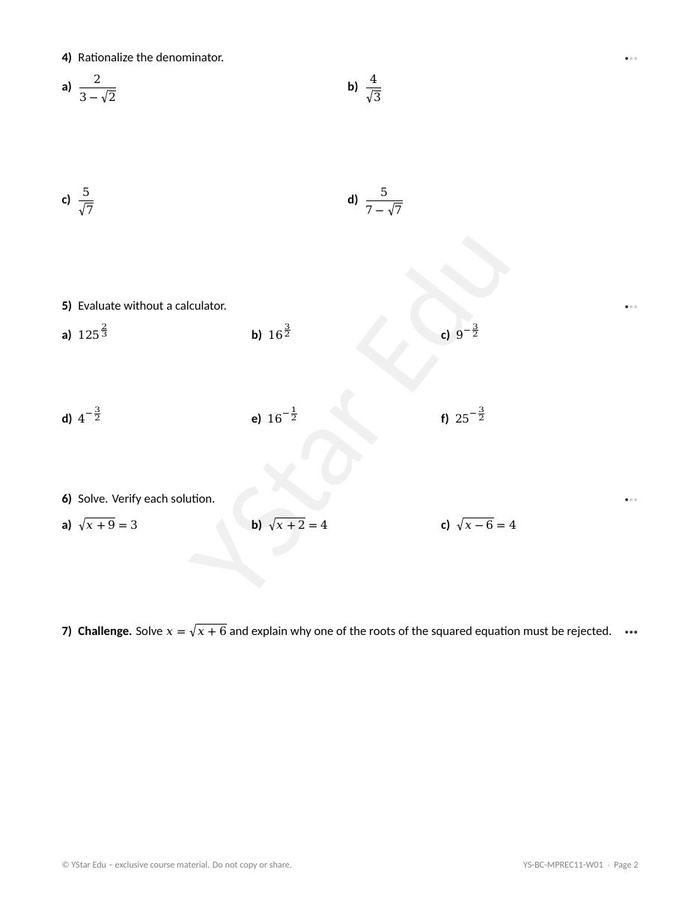
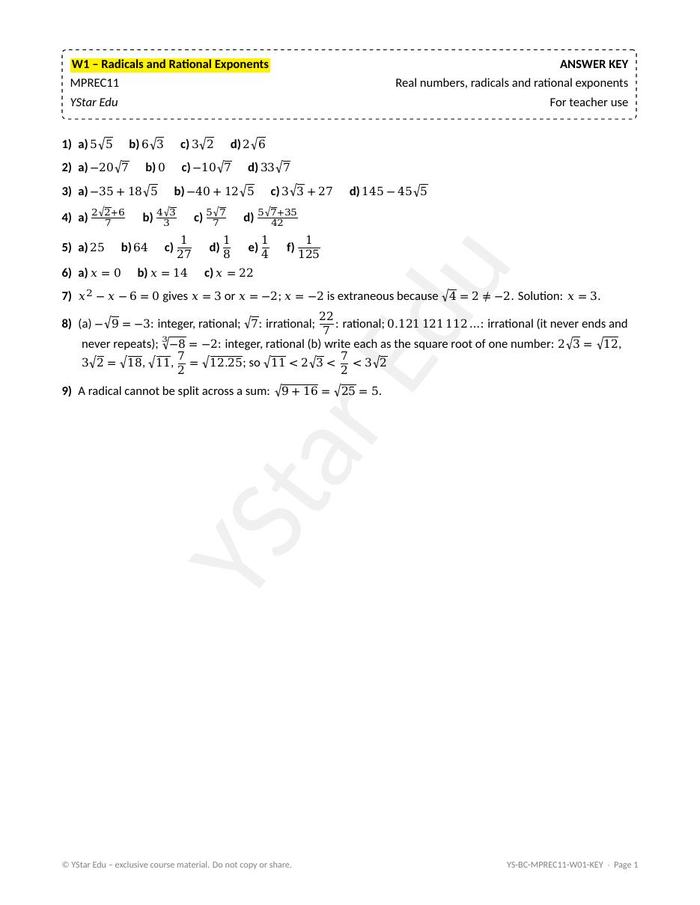
Real pages from this pack: the homework set, its answer key and the final exam. Every set follows this layout.


Topics in this pack
Each topic is a homework set with a separate answer key. Click a topic for details, or buy it on its own for CA$8.
Pre-Calculus 11 practice tests and the practice exam
A timed practice test comes after every two or three topics, each with its own answer key, so a unit is checked before the school test rather than after it.
Which practice test goes with which Pre-Calculus 11 unit
Schools number their units differently, so this table goes by unit name. Do the worksheets first, then sit the practice test for that unit with a timer running.
| Unit at school | Worksheets | Timed practice test |
|---|---|---|
| Radicals and Factoring | Topics 1–2 | Quiz 1 · 6 questions · 30 minutes |
| Rational Expressions and Quadratic Functions | Topics 3–4 | Quiz 2 · 6 questions · 30 minutes |
| Quadratic Equations and Inequalities | Topics 5–6 | Quiz 3 · 6 questions · 30 minutes |
| Trigonometry and Financial Literacy | Topics 7–8 | Quiz 4 · 6 questions · 30 minutes |
| Whole course, for exam review | All 8 topics | Practice exam · 78 marks · 120 minutes |
The Pre-Calculus 11 practice exam
- 120 minfinal exam
- 78 marksin 3 parts
- 14 marksPart A, multiple choice
- 34 marksPart B, short answer
- 30 marksPart C, written response
Every question on the final shows its marks, and the written-response questions in Part C are marked for complete, well-organized answers, not just the final result. A scientific calculator is the only permitted aid, the questions are new rather than repeated from the worksheets, and a separate answer key gives full solutions.
Pacing: 78 marks in 120 minutes is about 1.5 minutes a mark, which works out to roughly 20 minutes for Part A, 55 for Part B and 45 for Part C.
Using the pack for Pre-Calculus 11 exam review: in the last two weeks, practise factoring and completing the square until they are automatic, because every quadratic topic depends on them, then redo the Spot the Error question at the end of every worksheet. Finally, sit the final exam in 120 minutes with only a scientific calculator, and mark it with the answer key.
About Pre-Calculus 11
Pre-calculus 11 is the BC Grade 11 mathematics course for students heading toward Pre-calculus 12 and calculus. Like every course in BC’s curriculum, it is built around big ideas, curricular competencies and content; its content covers the real number system, radicals and rational exponents, polynomial factoring, rational expressions and equations, quadratic functions, equations and inequalities, trigonometry with angles in standard position and non-right triangles, and financial literacy. It is the usual prerequisite for Pre-calculus 12.
The pack follows the order most schools teach the course. Topics 1–3 build the algebra: radicals and rational exponents, polynomial factoring, and rational expressions and equations. Topics 4–6 are the quadratic core: quadratic functions in their three forms, quadratic equations, and linear and quadratic inequalities. Topic 7 covers trigonometry with angles in standard position and the sine and cosine laws, and Topic 8 is financial literacy: compound interest, investments and loans.
What each topic practises
What the questions in each worksheet cover, and the mistake each one warns about, taken from the worksheets themselves.
1Radicals and Rational Exponents
Mixed and entire radicals, simplifying, expanding and rationalizing denominators, evaluating powers with rational exponents without a calculator, solving radical equations and verifying each solution, rejecting an extraneous root, and classifying numbers as natural, whole, integer, rational or irrational.
Watch out: splitting a radical across a sum; not checking for extraneous roots.
2Polynomial Factoring
Common factors, trinomials and differences of squares, factoring with a quadratic pattern or a substitution, and possible dimensions of a rectangular prism from its volume.
Watch out: stopping before the expression is fully factored; sign errors in the factor pairs.
3Rational Expressions and Equations
Simplifying, multiplying, dividing, adding and subtracting rational expressions with their restrictions, solving rational equations and stating the non-permissible values, and work-rate problems with two painters and two taps.
Watch out: cancelling terms instead of factors; forgetting non-permissible values.
4Quadratic Functions
Vertex, axis of symmetry, direction of opening and optimal value, finite differences, transformations of y = x2, sketching parabolas, completing the square to reach vertex form, factored and standard forms, the equation of a parabola from given information, the price that maximizes revenue from phone cases, and a parabola through three points.
Watch out: confusing the zeros with the y-intercept; misreading the coordinates of the vertex.
5Quadratic Equations
Solving by factoring, by completing the square and with the quadratic formula, the discriminant and the number of real roots, consecutive integers, the dimensions of a rectangle, a ball thrown from the top of a building, the value of k that gives exactly one root, and fencing a pen along a river.
Watch out: solving before the equation equals zero; keeping a root that makes no sense in the context.
6Linear and Quadratic Inequalities
Solving linear and quadratic inequalities, interval notation and test points, graphing linear and quadratic inequalities in two variables with solid or dashed boundaries, when a ball is more than 16 m above the ground, and the values of k for which a quadratic is always positive.
Watch out: forgetting to reverse the sign when dividing by a negative; giving only one interval for a quadratic inequality.
7Trigonometry: Angles in Standard Position and Triangle Laws
Exact values for special angles, quadrants and reference angles, the primary ratios from a point on the terminal arm, the sine and cosine laws, the ambiguous case, a hiker’s journey on two bearings, and two boats seen from a lighthouse.
Watch out: ignoring the signs in each quadrant; assuming that SSA gives only one triangle.
8Financial Literacy: Compound Interest, Investments and Loans
Compound interest and present value, monthly deposits into an annuity, car-loan payments, the rule of 72, effective annual rates, and comparing compounding options with simple interest.
Watch out: using the annual interest rate as the rate per compounding period.
A question from the free sample, worked
Spot the Error. A student wrote: √(9 + 16) = 3 + 4 = 7. Find the mistake, explain why it is wrong, and write a correct solution.
Solution. A square root cannot be split across a sum: √(a + b) is not √a + √b. Add first, then take the root: √(9 + 16) = √25 = 5.
This is question 9 of Topic 1, Radicals and Rational Exponents, part of the free sample. Every worksheet in the pack ends with a “Spot the Error” question like this one, because finding someone else's mistake is one of the quickest ways to stop making it.
Where students lose marks in Pre-Calculus 11
- A square root does not split across a sum. √(9 + 16) = √25 = 5, not 3 + 4.
- Check the signs of the factors. x2 − 5x + 6 = (x − 2)(x − 3): the numbers must multiply to +6 and add to −5.
- Cancel factors, not terms. x/(x + 5) cannot be simplified to 1/5 by cancelling the x; only a factor of the whole numerator and the whole denominator cancels.
- The vertex of y = a(x − p)2 + q is (p, q). For y = 2(x + 3)2 − 5, p = −3, so the vertex is (−3, −5), not (3, −5).
- Set the equation equal to zero first. x2 − 3x = 10 becomes x2 − 3x − 10 = 0, so (x − 5)(x + 2) = 0 and x = 5 or x = −2.
- A quadratic inequality can have two boundaries. x2 < 9 means −3 < x < 3, not just x < 3.
- Watch the quadrant. cos 150° = −cos 30° = −√3/2, because cosine is negative in quadrant II.
- SSA can give two triangles. In the ambiguous case, check whether a second, obtuse angle also works before stopping at one answer.
- Use the rate per period. At 6% a year compounded monthly, i = 0.06 ÷ 12 = 0.005 and n = 12 for one year.
Not sure which of these apply? The free diagnostic test shows which topics to start with.
Before and after Pre-Calculus 11
Before: Foundations of Mathematics and Pre-Calculus 10 is the prerequisite. Its work on factoring, exponents, linear relations and systems is the starting point of Pre-calculus 11.
After: Pre-Calculus 12 builds directly on Pre-calculus 11: quadratics and factoring lead into polynomial and rational functions, and angles in standard position lead into the unit circle and radian measure.
Questions parents ask
Is there a free Pre-Calculus 11 practice test?
Yes. Quiz 1 is a free timed practice test with its own answer key, a PDF with no sign-in. Topic 1’s complete worksheet and answer key are free in the same way, and so is the online diagnostic test, which takes 30 to 45 minutes and reports the result topic by topic. The other 3 timed practice tests and the practice exam come with the full pack.
Does the Pre-Calculus 11 practice exam come with answers?
Yes. The practice exam has a complete answer key, and every worksheet and practice test in the pack has its own answer key too.
How long is the Pre-Calculus 11 exam?
Each school sets the length of its own exam, so ask your teacher. The practice exam in this pack is 120 minutes for 78 marks.
What is in the PREC11 practice pack?
8 homework sets (one per topic, 72 questions in Core, Applied and Extension tiers) with full worked answer keys, 4 timed stage quizzes and a final exam, all as PDFs you can print or use on a tablet.
How long do I have access?
Until June 30, 2027, the end of the 2026–27 school year. It is a one-time payment and does not renew.
Can I buy a single topic?
Yes. Each topic below is sold on its own for CA$8 (homework set and answer key). The quizzes and the final exam come with the full pack.
Can I see a sample first?
Yes. The first topic's complete homework set and answer key can be downloaded free, without signing in, from the course page in the store.
Is Pre-Calculus 11 harder than Foundations of Mathematics 11?
Pre-calculus 11 has more algebra, especially factoring, rational expressions and quadratics, and it leads to Pre-calculus 12 and calculus. Foundations of Mathematics 11 puts more weight on reasoning, statistics and applied problems.
Can I use the pack for Pre-Calculus 11 exam review?
Yes. The four practice tests each check two topics, and the final exam is a full 120-minute paper with new questions, 78 marks across multiple choice, short answer and written response, with a complete answer key.
Does the pack include financial literacy?
Yes. Topic 8 covers compound interest, present value, annuities, loans, the rule of 72 and effective annual rates.
Get the Pre-Calculus 11 practice pack
8 worksheets with worked answers, 4 timed practice tests and a practice exam, as printable PDFs. Start with the free sample: the first topic’s complete worksheet and answer key.
One payment, no auto-renewal · access until June 30, 2027 · 7-day refund if nothing has been downloaded · secure checkout by Stripe
Other British Columbia courses
- Life Sciences 11 Grade 11 · Biology
- Anatomy and Physiology 12 Grade 12 · Biology
- Chemistry 11 Grade 11 · Chemistry
- Chemistry 12 Grade 12 · Chemistry
- English 9 Grade 9 · English
- Composition 10 Grade 10 · English
- Literary Studies 10 Grade 10 · English
- Composition 11 Grade 11 · English
- Literary Studies 11 Grade 11 · English
- English Studies 12 Grade 12 · English
- Mathematics 9 Grade 9 · Math
- Foundations of Mathematics and Pre-Calculus 10 Grade 10 · Math
- Foundations of Mathematics 11 Grade 11 · Math
- Calculus 12 Grade 12 · Math
- Foundations of Mathematics 12 Grade 12 · Math
- Pre-Calculus 12 Grade 12 · Math
- Physics 11 Grade 11 · Physics
- Physics 12 Grade 12 · Physics
- Science 9 Grade 9 · Science
- Science 10 Grade 10 · Science
All-access: every course pack for one payment, until June 30, 2027.