
BC · Grade 10 · English · LITST10
BC Literary Studies 10: practice exam, exam review and practice tests
Every Literary Studies 10 unit, practised the way it is tested: a worksheet for each topic, with Core / Applied / Extension questions and model answers, original passages, poems and stories to work with, a timed practice test after every two topics, and a complete final exam for exam review.
- 6 topics
- 6 homework sets
- 33 questions
- 3 stage quizzes
- 1 final exam
- PDF download
One payment, no auto-renewal · access until June 30, 2027 · 7-day refund if nothing has been downloaded · secure checkout by Stripe

Preview pages
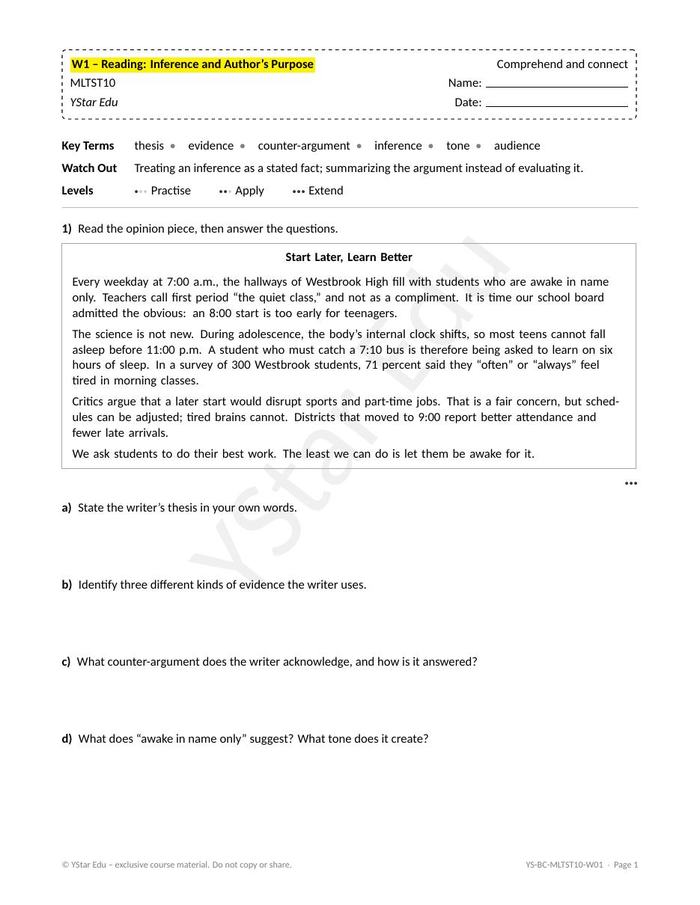
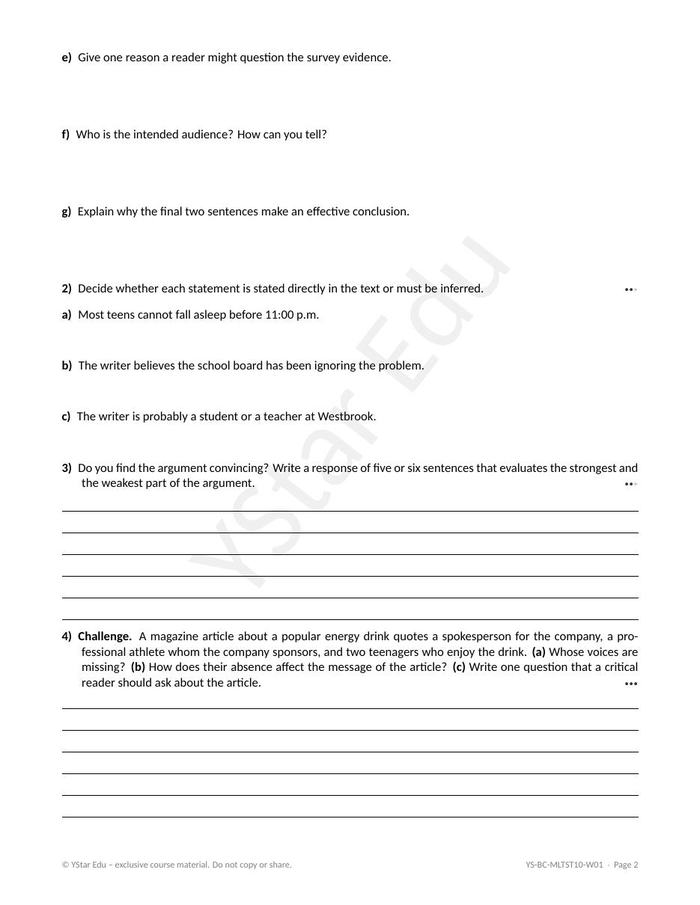
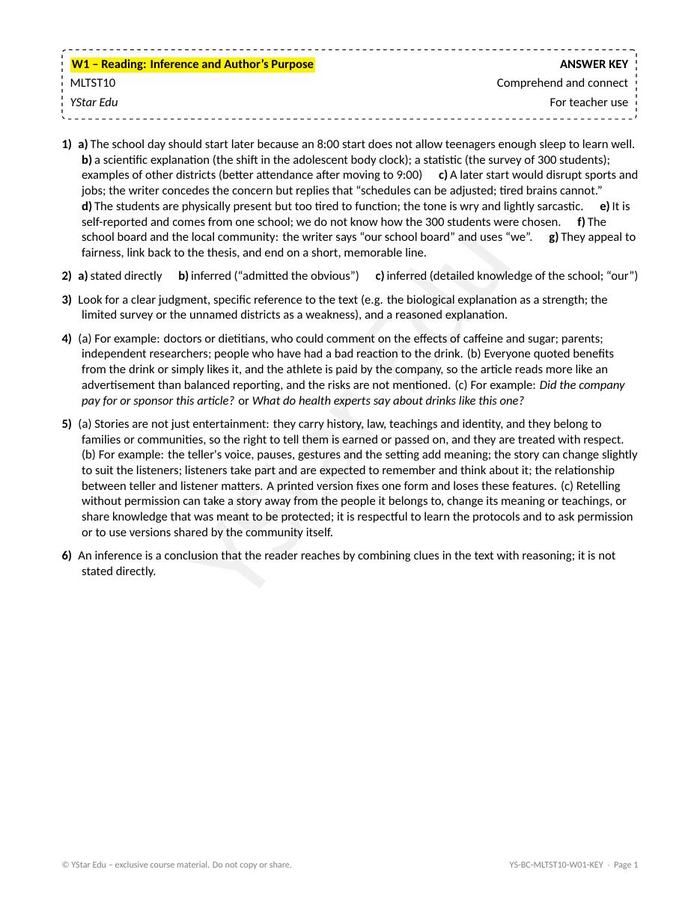
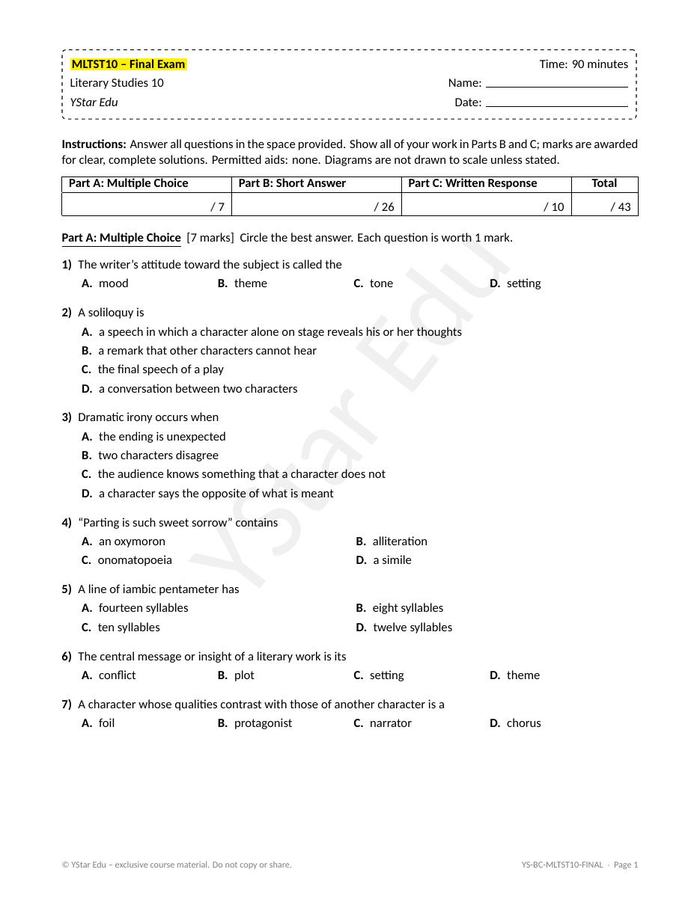
Real pages from this pack: the homework set, its answer key and the final exam. Every set follows this layout.
Topics in this pack
Each topic is a homework set with a separate answer key. Click a topic for details, or buy it on its own for CA$8.
Literary Studies 10 practice tests and the practice exam
A timed practice test comes after every two topics, each with model answers, so a unit is checked before the school test rather than after it.
Which practice test goes with which Literary Studies 10 unit
Schools number their units differently, so this table goes by unit name. Do the worksheets first, then sit the practice test for that unit with a timer running.
| Unit at school | Worksheets | Timed practice test |
|---|---|---|
| Reading and Literary Analysis | Topics 1–2 | Quiz 1 · 4 questions · 25 minutes |
| Poetry and Shakespeare | Topics 3–4 | Quiz 2 · 4 questions · 20 minutes |
| Setting and Drama | Topics 5–6 | Quiz 3 · 4 questions · 25 minutes |
| Whole course, for exam review | All 6 topics | Practice exam · 43 marks · 90 minutes |
The Literary Studies 10 practice exam
- 90 minfinal exam
- 43 marksin 3 parts
- 7 marksPart A, multiple choice
- 26 marksPart B, short answers on an unseen opinion piece and poem
- 10 marksPart C, an analytical paragraph on the poem
Every question on the final shows its marks. No aids are permitted, the opinion piece and the poem are new, and a separate answer key gives model answers.
Pacing: 43 marks in 90 minutes is about 2.1 minutes a mark, which works out to roughly 15 minutes for Part A, 55 for Part B and 20 for Part C.
Using the pack for Literary Studies 10 exam review: in the last two weeks, revise the literary terms in each topic, then write an analytical paragraph on a poem against the clock and compare it with the model answer. Finally, sit the final exam in 90 minutes: an unseen opinion piece and poem, then a paragraph analysing the poem.
About Literary Studies 10
Literary Studies 10 is one of the two-credit Grade 10 English Language Arts courses in BC; most students combine it with a second one, such as Composition 10, to complete Grade 10 English. Like every course in BC’s curriculum, it is built around big ideas, curricular competencies and content, and Literary Studies focuses on reading: exploring how stories, poems and plays are built, and responding to them with evidence. Grade 10 is also the year most BC students write the provincial Graduation Literacy Assessment 10.
The pack covers the course in six topics. Topic 1 is reading for inference and the author’s purpose, Topic 2 character, conflict and theme in a short story, and Topic 3 tone, mood and figurative language in poetry. Topic 4 is Shakespeare, with Romeo and Juliet as the main example, Topic 5 setting, mood and symbolism, and Topic 6 reading drama.
What each topic practises
What the questions in each worksheet cover, and the mistake each one warns about, taken from the worksheets themselves.
1Reading: Inference and Author’s Purpose
An original opinion piece read for thesis, evidence, counter-argument, tone and audience, what is stated and what must be inferred, judging the strongest and weakest parts of the argument, a magazine article that quotes a sponsor’s spokesperson, and the protocols in many First Peoples communities about who may tell a story.
Watch out: treating an inference as a stated fact; summarizing the argument instead of evaluating it.
2Literary Analysis: Character, Conflict and Theme
An original short story, “Translation”, whose narrator has interpreted for a grandmother at medical appointments since the age of nine, read for narrator, characterization, internal conflict, irony and symbol, a theme stated as a full sentence with evidence, and direct and indirect characterization.
Watch out: stating a theme as a single word; giving evidence without analysis.
3Poetry: Tone, Mood and Figurative Language
An original free-verse poem read for speaker, tone, mood, imagery and enjambment, why a poet might choose free verse, the image that best expresses the theme, and reading song lyrics as poetry.
Watch out: confusing tone with mood; assuming that the speaker is the poet.
4Shakespeare: Language and Dramatic Techniques
Elizabethan words and their modern meanings, iambic pentameter in Romeo and Juliet, literary devices in quotations, soliloquy, aside, dramatic irony, foil and tragic flaw, the dramatic irony of the tomb scene, how one character’s decision leads to disaster, and “But, soft! what light through yonder window breaks?” in modern English.
Watch out: reading Elizabethan words with their modern meanings; confusing a soliloquy with an aside.
5Setting, Mood and Symbolism
An original passage about Elena and an orchard, read for setting, mood, atmosphere, symbol and imagery, a paragraph on how the orchard reflects her feelings, and five sentences that make a place feel tense without saying so.
Watch out: describing a character’s feelings when asked for the mood; naming a symbol without explaining what it stands for.
6Reading Drama: Dialogue and Stage Directions
An original scene between Mara and a clerk, read for stage directions, dialogue, subtext, monologue and conflict, six more lines of the scene with stage directions, and the scene rewritten as prose narration.
Watch out: ignoring the stage directions; quoting a line without considering how it would be spoken.
A question from the free sample, worked
Spot the Error. A student says: “An inference is a fact that is stated directly in the text.” Find the mistake, explain why it is wrong, and write a correct solution.
Solution. An inference is not stated in the text. It is a conclusion the reader draws by combining clues in the text with reasoning: a character who “checked the clock for the fifth time” is never called impatient, but the reader infers it.
This is question 6 of Topic 1, Reading: Inference and Author’s Purpose, part of the free sample. Every worksheet in the pack ends with a “Spot the Error” question like this one, because finding someone else's mistake is one of the quickest ways to stop making it.
Where students lose marks in Literary Studies 10
- A theme is a sentence, not a word. “Love” is a topic; a theme is a full statement about it, such as “Love can be shown more clearly in actions than in words.”
- Tone is not mood. Tone is the writer’s or speaker’s attitude; mood is the feeling the text creates in the reader.
- The speaker is not always the poet. Write “the speaker” unless the poem is clearly about the poet’s own life.
- “Wherefore” means “why”. When Juliet asks “Wherefore art thou Romeo?”, she is asking why he must be Romeo, a Montague, not where he is.
- Soliloquy or aside? A soliloquy is a speech a character makes alone on stage; an aside is a short remark that the other characters on stage do not hear.
- Mood is not a character’s feeling. “Elena is sad” describes the character; the mood is the feeling the passage creates in the reader.
- Explain what a symbol stands for. Calling the orchard a symbol earns little; say what it represents and how the passage shows it.
- Stage directions matter. They tell actors and readers how lines are spoken and what characters do, so they are evidence too.
- Analyse your evidence. A quotation followed by nothing is not analysis; say what it shows about the character or the theme.
Not sure which of these apply? The free diagnostic test shows which topics to start with.
Before and after Literary Studies 10
Before: Literary Studies 10 builds on English 9, where students learn to read for the main idea, describe characters with evidence and write a clear paragraph.
After: Literary Studies 11 continues the course: rhetorical analysis, the sonnet, Shakespearean tragedy and comparing texts extend the reading practised here.
Questions parents ask
Is there a free Literary Studies 10 practice test?
Yes. Quiz 1 is a free timed practice test with its own answer key, a PDF with no sign-in. Topic 1’s complete worksheet and answer key are free in the same way, and so is the online diagnostic test, which takes 30 to 45 minutes and reports the result topic by topic. The other 2 timed practice tests and the practice exam come with the full pack.
How long is the Literary Studies 10 exam?
Each school sets the length of its own exam, so ask your teacher. The practice exam in this pack is 90 minutes for 43 marks.
What is in the LITST10 practice pack?
6 homework sets (one per topic, 33 questions in Core, Applied and Extension tiers) with full worked answer keys, 3 timed stage quizzes and a final exam, all as PDFs you can print or use on a tablet.
How long do I have access?
Until June 30, 2027, the end of the 2026–27 school year. It is a one-time payment and does not renew.
Can I buy a single topic?
Yes. Each topic below is sold on its own for CA$8 (homework set and answer key). The quizzes and the final exam come with the full pack.
Can I see a sample first?
Yes. The first topic's complete homework set and answer key can be downloaded free, without signing in, from the course page in the store.
Which Shakespeare play does the pack use?
Topic 4 uses Romeo and Juliet for its quotations and examples, and the questions on dramatic techniques can be answered with any Shakespeare play studied in class.
Is Literary Studies 10 a full English course?
Literary Studies 10 is a two-credit course. Most BC students combine it with a second two-credit English Language Arts 10 course, such as Composition 10, to complete Grade 10 English.
Can I use the pack for Literary Studies 10 exam review?
Yes. The three practice tests each check two topics, and the final exam is a 90-minute paper, 43 marks across multiple choice, short answers on an unseen opinion piece and poem, and an analytical paragraph, with model answers.
Get the Literary Studies 10 practice pack
6 worksheets with worked answers, 3 timed practice tests and a practice exam, as printable PDFs. Start with the free sample: the first topic’s complete worksheet and answer key.
One payment, no auto-renewal · access until June 30, 2027 · 7-day refund if nothing has been downloaded · secure checkout by Stripe
Other British Columbia courses
- Life Sciences 11 Grade 11 · Biology
- Anatomy and Physiology 12 Grade 12 · Biology
- Chemistry 11 Grade 11 · Chemistry
- Chemistry 12 Grade 12 · Chemistry
- English 9 Grade 9 · English
- Composition 10 Grade 10 · English
- Composition 11 Grade 11 · English
- Literary Studies 11 Grade 11 · English
- English Studies 12 Grade 12 · English
- Mathematics 9 Grade 9 · Math
- Foundations of Mathematics and Pre-Calculus 10 Grade 10 · Math
- Foundations of Mathematics 11 Grade 11 · Math
- Pre-Calculus 11 Grade 11 · Math
- Calculus 12 Grade 12 · Math
- Foundations of Mathematics 12 Grade 12 · Math
- Pre-Calculus 12 Grade 12 · Math
- Physics 11 Grade 11 · Physics
- Physics 12 Grade 12 · Physics
- Science 9 Grade 9 · Science
- Science 10 Grade 10 · Science
All-access: every course pack for one payment, until June 30, 2027.