
BC · Grade 9 · English · ENG9
BC English 9: practice exam, exam review and practice tests
Every English 9 unit, practised the way it is tested: a worksheet for each topic, with Core / Applied / Extension questions and model answers, original passages, poems and stories to work with, a timed practice test after every two topics, and a complete final exam for exam review.
- 8 topics
- 8 homework sets
- 54 questions
- 4 stage quizzes
- 1 final exam
- PDF download
One payment, no auto-renewal · access until June 30, 2027 · 7-day refund if nothing has been downloaded · secure checkout by Stripe

Preview pages
Real pages from this pack: the homework set, its answer key and the final exam. Every set follows this layout.



Topics in this pack
Each topic is a homework set with a separate answer key. Click a topic for details, or buy it on its own for CA$8.
English 9 practice tests and the practice exam
A timed practice test comes after every two topics, each with model answers, so a unit is checked before the school test rather than after it.
Which practice test goes with which English 9 unit
Schools number their units differently, so this table goes by unit name. Do the worksheets first, then sit the practice test for that unit with a timer running.
| Unit at school | Worksheets | Timed practice test |
|---|---|---|
| Reading and Short Stories | Topics 1–2 | Quiz 1 · 4 questions · 25 minutes |
| Poetry and Grammar | Topics 3–4 | Quiz 2 · 4 questions · 20 minutes |
| Paragraph Writing and Media | Topics 5–6 | Quiz 3 · 4 questions · 20 minutes |
| Character and Vocabulary | Topics 7–8 | Quiz 4 · 4 questions · 20 minutes |
| Whole course, for exam review | All 8 topics | Practice exam · 70 marks · 120 minutes |
The English 9 practice exam
- 120 minfinal exam
- 70 marksin 3 parts
- 14 marksPart A, multiple choice
- 31 marksPart B, short answers on an unseen story and poem
- 25 marksPart C, an analytical paragraph and a written opinion
Every question on the final shows its marks. No aids are permitted, the story and the poem are new, and a separate answer key gives model answers.
Pacing: 70 marks in 120 minutes is about 1.7 minutes a mark, which works out to roughly 25 minutes for Part A, 50 for Part B and 45 for Part C.
Using the pack for English 9 exam review: in the last two weeks, revise the literary devices, the stages of a plot and the grammar rules in Topic 4, then write an analytical paragraph and an opinion response against the clock and compare them with the model answers. Finally, sit the final exam in 120 minutes.
About English 9
English Language Arts 9 is the BC Grade 9 English course. Like every course in BC’s curriculum, it is built around big ideas, curricular competencies and content: reading and responding to stories, poems, informational texts and media, and writing and speaking clearly for different purposes. It prepares students for the Grade 10 English Language Arts courses, such as Composition 10 and Literary Studies 10.
The pack covers the course in eight topics. Topic 1 is reading informational texts, Topics 2–3 are short story elements and poetry and literary devices, and Topic 4 grammar and sentence structure. Topic 5 teaches paragraph writing, Topic 6 media literacy, Topic 7 character analysis, and Topic 8 vocabulary and word study.
What each topic practises
What the questions in each worksheet cover, and the mistake each one warns about, taken from the worksheets themselves.
1Reading Informational Texts
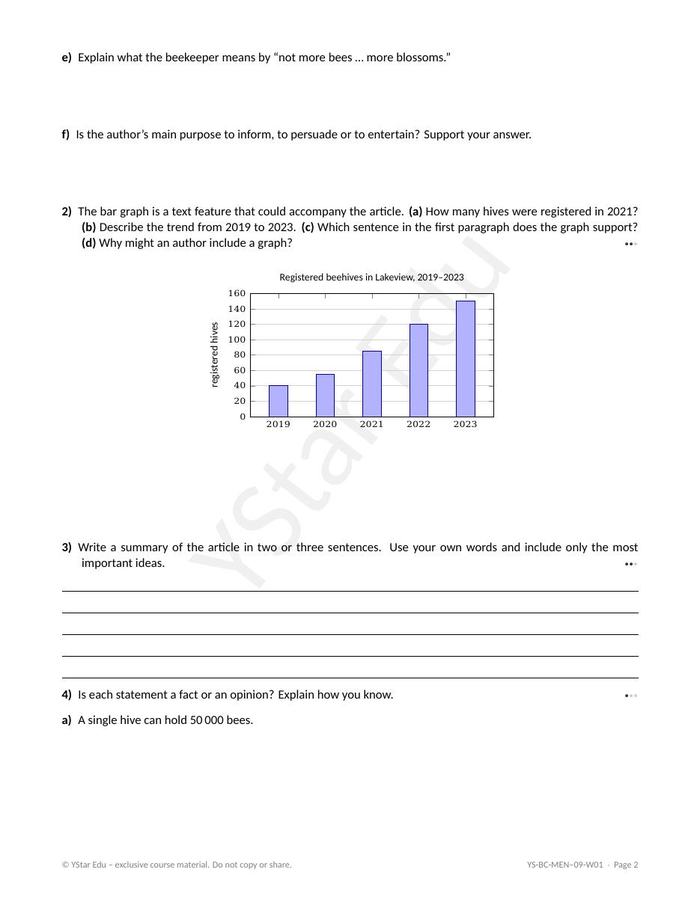
An original article, “City Bees”, on rooftop beekeeping, read for main idea, supporting details, inference and context clues, a bar graph as a text feature, a short summary in your own words, fact and opinion, a claim about team sports and grades based on a small survey, previewing an article, and the bias in a brochure for a new mall.
Watch out: giving a detail instead of the main idea; copying sentences instead of summarizing in your own words.
2Short Story Elements
An original short story, “The Last Bus”, read for setting, protagonist, conflict, point of view and plot, the five stages of a plot diagram, and a paragraph on how Maya’s opinion of Mr. Aldous changes.
Watch out: confusing the topic with the theme; retelling the plot instead of explaining it.
3Poetry and Literary Devices
An original poem read for simile, metaphor, personification, alliteration, imagery and rhyme scheme, naming the device in each sentence, and four lines of your own about a season.
Watch out: calling every comparison a simile; forgetting that a metaphor does not use “like” or “as”.
4Grammar and Sentence Structure
Parts of speech, sentences, fragments and run-ons, capitalization and punctuation, simple, compound and complex sentences, combining sentences, commonly confused words, and pronoun forms.
Watch out: mixing up their, there and they’re; joining two sentences with only a comma.
5Paragraph Writing
Putting a paragraph in order, topic sentences and supporting evidence, transitions and concluding sentences, strengthening weak topic sentences, a planned paragraph on phones at lunch, and support for the claim that every student should learn to cook.
Watch out: announcing the topic (“This paragraph is about…”) instead of making a point; giving evidence without explaining it.
6Media Literacy
An original advertisement for a drink called FrostByte, read for audience, purpose and fine print, advertising techniques, reliable and unreliable sources, two headlines that report the same council decision differently, and preparing a two-minute talk.
Watch out: accepting a statistic without checking who collected it; confusing a fact with an opinion.
7Character Analysis: Traits, Motives and Change
An original story, “The Science Fair”, about Dev, his sister Anika and a model volcano, read for traits, motives and change, direct and indirect characterization, dynamic and static characters, and a paragraph on the relationship between brother and sister.
Watch out: listing a trait without evidence; confusing what a character says with what the character is like.
8Vocabulary and Word Study
Prefixes, roots and suffixes, context clues, connotation and denotation, choosing the most precise word, and building words from the roots bene, mal and dict.
Watch out: guessing a meaning without checking the context; ignoring connotation when choosing a word.
A question from the free sample, worked
Spot the Error. A student says: “The main idea of the article City Bees is that a single hive can hold 50 000 bees.” Find the mistake, explain why it is wrong, and write a correct solution.
Solution. The size of a hive is a supporting detail. The main idea is the point of the whole article: rooftop beekeeping is growing in cities and brings both benefits and concerns, and details such as the number of bees in a hive back up that point.
This is question 8 of Topic 1, Reading Informational Texts, part of the free sample. Every worksheet in the pack ends with a “Spot the Error” question like this one, because finding someone else's mistake is one of the quickest ways to stop making it.
Where students lose marks in English 9
- The climax is not the first event. It is the turning point, the moment of greatest tension, which comes after the rising action.
- A metaphor does not use “like” or “as”. “The snow was a white blanket” is a metaphor; “the snow was like a white blanket” is a simile.
- A fragment is not a sentence. “Because I was late.” has a subject and a verb, but it is not a complete thought; join it to a main clause.
- Their, there and they’re. Their shows ownership, there is a place, and they’re means “they are”.
- Make a point in your topic sentence. “In this paragraph I am going to talk about recycling” announces a topic; “Recycling at school saves money and resources” makes a point.
- Check who collected the statistic. “9 out of 10 athletes choose FrostByte” comes from ten athletes the company sponsors, so it proves nothing about the drink.
- A small survey is weak evidence. A claim about all teenagers based on 40 students, with no allowance for other causes, is a hasty generalization.
- What a character says is not who the character is. Read Anika’s remark about the volcano in context, together with what she does, before deciding what she is like.
- Use context clues. Work out an unfamiliar word from the words around it; the sentence about three different models shows that “ambiguous” means unclear.
Not sure which of these apply? The free diagnostic test shows which topics to start with.
Before and after English 9
Before: English 9 builds on Grade 8 English Language Arts. Each topic starts with Core questions on the basics, so no extra background is needed.
After: English 9 leads to the Grade 10 English Language Arts courses, such as Composition 10 and Literary Studies 10, which build on its paragraph writing and close reading.
Questions parents ask
Is there a free English 9 practice test?
Yes. Quiz 1 is a free timed practice test with its own answer key, a PDF with no sign-in. Topic 1’s complete worksheet and answer key are free in the same way, and so is the online diagnostic test, which takes 30 to 45 minutes and reports the result topic by topic. The other 3 timed practice tests and the practice exam come with the full pack.
How long is the English 9 exam?
Each school sets the length of its own exam, so ask your teacher. The practice exam in this pack is 120 minutes for 70 marks.
What is in the ENG9 practice pack?
8 homework sets (one per topic, 54 questions in Core, Applied and Extension tiers) with full worked answer keys, 4 timed stage quizzes and a final exam, all as PDFs you can print or use on a tablet.
How long do I have access?
Until June 30, 2027, the end of the 2026–27 school year. It is a one-time payment and does not renew.
Can I buy a single topic?
Yes. Each topic below is sold on its own for CA$8 (homework set and answer key). The quizzes and the final exam come with the full pack.
Can I see a sample first?
Yes. The first topic's complete homework set and answer key can be downloaded free, without signing in, from the course page in the store.
Does the pack teach paragraph writing?
Yes. Topic 5 covers topic sentences, evidence, explanation, transitions and concluding sentences, and the analytical paragraphs in Topics 2 and 7 practise the same structure, with model answers.
Can I use the pack for English 9 exam review?
Yes. The four practice tests check every topic, and the final exam is a full 120-minute paper, 70 marks across multiple choice, short answers on an unseen story and poem, an analytical paragraph and a written opinion, with model answers.
Which course comes after English 9?
Most BC students take two of the two-credit Grade 10 English Language Arts courses, such as Composition 10 and Literary Studies 10.
Get the English 9 practice pack
8 worksheets with worked answers, 4 timed practice tests and a practice exam, as printable PDFs. Start with the free sample: the first topic’s complete worksheet and answer key.
One payment, no auto-renewal · access until June 30, 2027 · 7-day refund if nothing has been downloaded · secure checkout by Stripe
Other British Columbia courses
- Life Sciences 11 Grade 11 · Biology
- Anatomy and Physiology 12 Grade 12 · Biology
- Chemistry 11 Grade 11 · Chemistry
- Chemistry 12 Grade 12 · Chemistry
- Composition 10 Grade 10 · English
- Literary Studies 10 Grade 10 · English
- Composition 11 Grade 11 · English
- Literary Studies 11 Grade 11 · English
- English Studies 12 Grade 12 · English
- Mathematics 9 Grade 9 · Math
- Foundations of Mathematics and Pre-Calculus 10 Grade 10 · Math
- Foundations of Mathematics 11 Grade 11 · Math
- Pre-Calculus 11 Grade 11 · Math
- Calculus 12 Grade 12 · Math
- Foundations of Mathematics 12 Grade 12 · Math
- Pre-Calculus 12 Grade 12 · Math
- Physics 11 Grade 11 · Physics
- Physics 12 Grade 12 · Physics
- Science 9 Grade 9 · Science
- Science 10 Grade 10 · Science
All-access: every course pack for one payment, until June 30, 2027.