
BC · Grade 10 · Math · MATH10
BC Foundations of Mathematics and Pre-Calculus 10: practice exam, exam review and practice tests
Every Foundations of Mathematics and Pre-Calculus 10 unit, practised the way it is tested: a worksheet for each topic in the order most BC schools teach it, with Core / Applied / Extension questions and full worked solutions, a timed practice test after every two topics, and a complete final exam with new questions for exam review.
- 10 topics
- 10 homework sets
- 80 questions
- 5 stage quizzes
- 1 final exam
- PDF download
One payment, no auto-renewal · access until June 30, 2027 · 7-day refund if nothing has been downloaded · secure checkout by Stripe

Preview pages
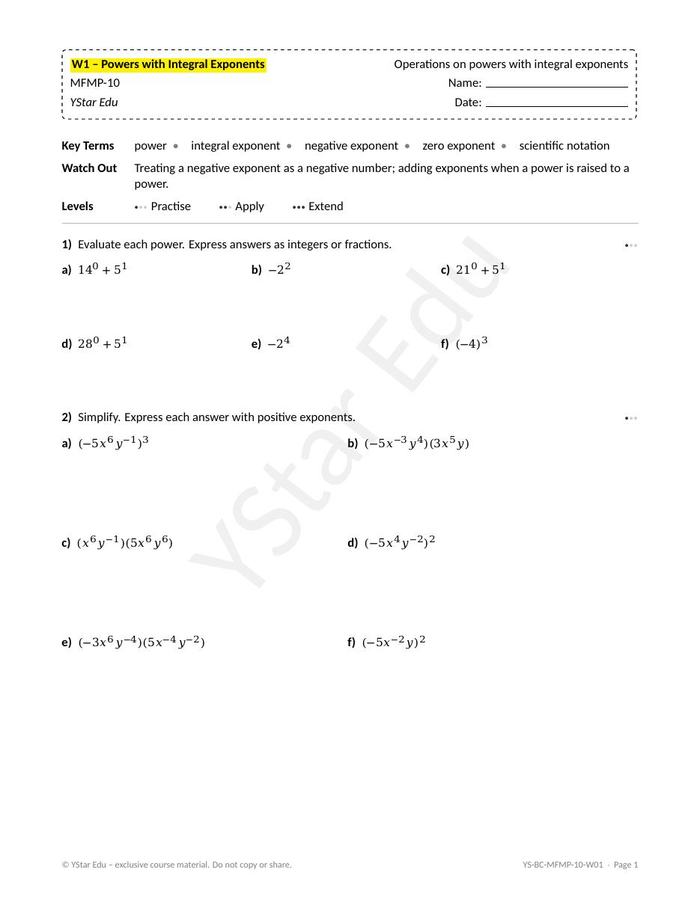
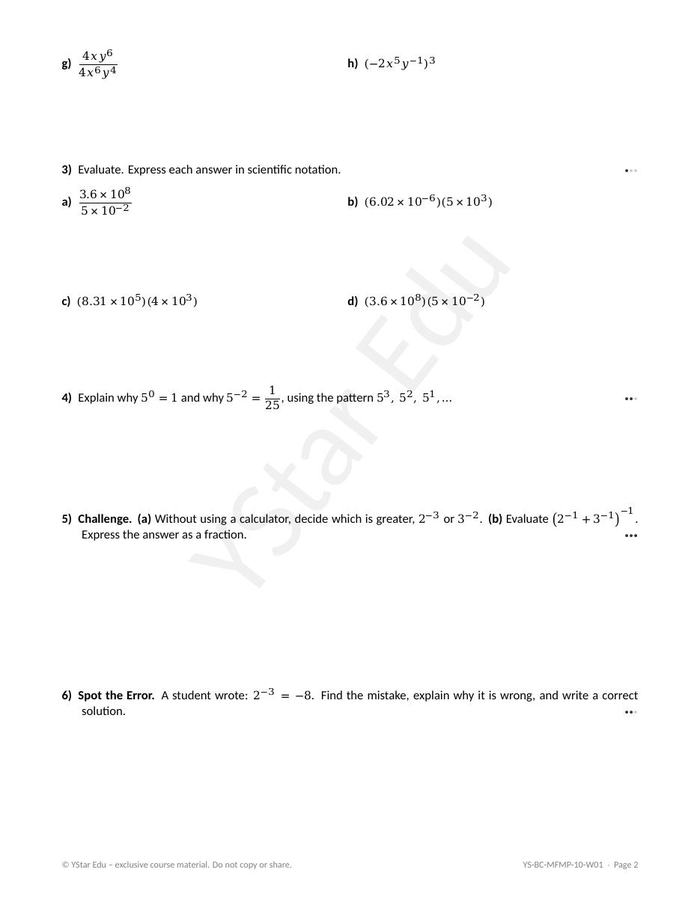
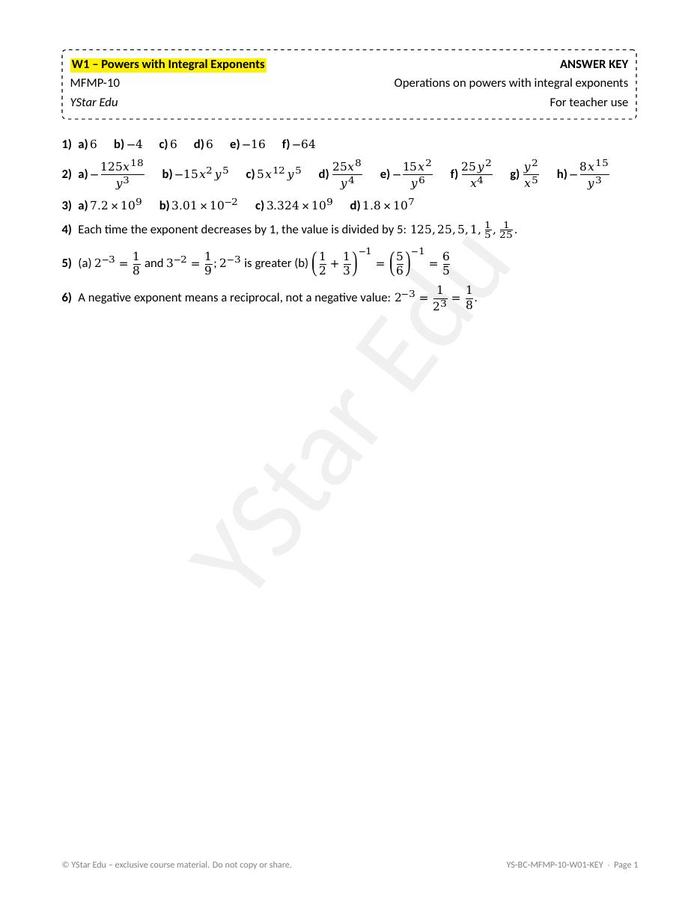
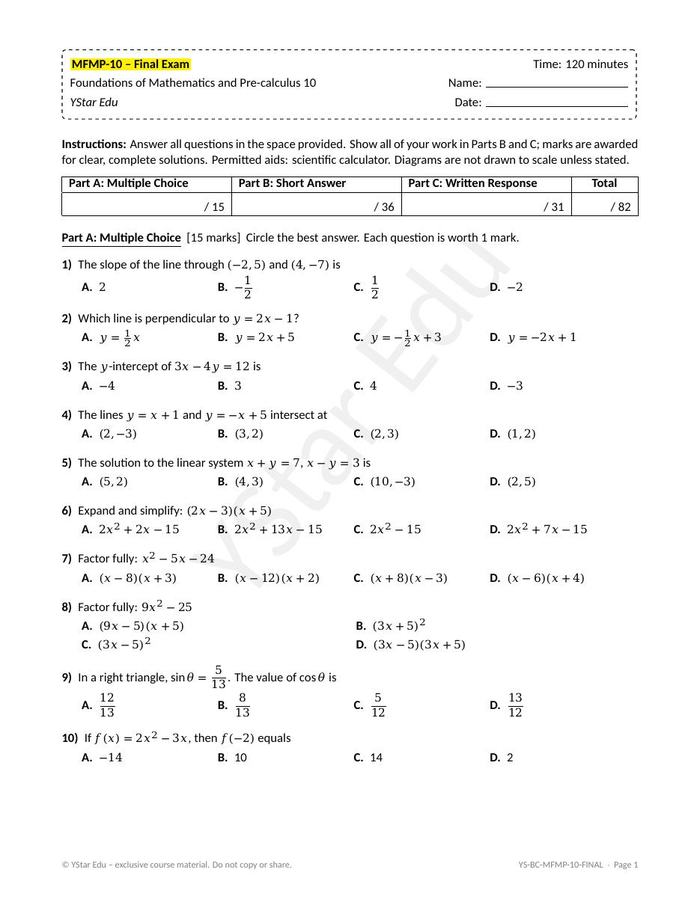
Real pages from this pack: the homework set, its answer key and the final exam. Every set follows this layout.
Topics in this pack
Each topic is a homework set with a separate answer key. Click a topic for details, or buy it on its own for CA$8.
Foundations of Mathematics and Pre-Calculus 10 practice tests and the practice exam
A timed practice test comes after every two or three topics, each with its own answer key, so a unit is checked before the school test rather than after it.
Which practice test goes with which Foundations of Mathematics and Pre-Calculus 10 unit
Schools number their units differently, so this table goes by unit name. Do the worksheets first, then sit the practice test for that unit with a timer running.
| Unit at school | Worksheets | Timed practice test |
|---|---|---|
| Powers and Prime Factorization | Topics 1–2 | Quiz 1 · 6 questions · 30 minutes |
| Functions and Linear Functions | Topics 3–4 | Quiz 2 · 7 questions · 30 minutes |
| Sequences and Linear Systems | Topics 5–6 | Quiz 3 · 6 questions · 30 minutes |
| Polynomials and Factoring | Topics 7–8 | Quiz 4 · 6 questions · 30 minutes |
| Trigonometry and Financial Literacy | Topics 9–10 | Quiz 5 · 7 questions · 30 minutes |
| Whole course, for exam review | All 10 topics | Practice exam · 82 marks · 120 minutes |
The Foundations of Mathematics and Pre-Calculus 10 practice exam
- 120 minfinal exam
- 82 marksin 3 parts
- 15 marksPart A, multiple choice
- 36 marksPart B, short answer
- 31 marksPart C, written response
Every question on the final shows its marks, and the written-response questions in Part C are marked for complete, well-organized answers, not just the final result. A scientific calculator is the only permitted aid, the questions are new rather than repeated from the worksheets, and a separate answer key gives full solutions.
Pacing: 82 marks in 120 minutes is about 1.5 minutes a mark, which works out to roughly 20 minutes for Part A, 55 for Part B and 45 for Part C.
Using the pack for Foundations of Math and Pre-Calculus 10 exam review: in the last two weeks, practise factoring and the equations of lines until they are quick, then redo the Spot the Error question at the end of every worksheet. Finally, sit the final exam in 120 minutes with only a scientific calculator, and mark it with the answer key.
About Foundations of Math and Pre-Calculus 10
Foundations of Mathematics and Pre-calculus 10 is the BC Grade 10 math course that leads to both Foundations of Mathematics 11 and Pre-calculus 11. Like every course in BC’s curriculum, it is built around big ideas, curricular competencies and content; its content covers powers with integral exponents, prime factorization, functions and relations, linear functions, arithmetic sequences, systems of linear equations, multiplying and factoring polynomials, the primary trigonometric ratios, and financial literacy: gross and net pay. Grade 10 is also the year most BC students write the provincial Graduation Numeracy Assessment.
The pack follows the order most schools teach the course. Topics 1–2 are number: powers with integral exponents and prime factorization. Topics 3–6 cover relations and functions: domain and range, slope and the equations of lines, arithmetic sequences, and systems of linear equations. Topics 7–8 are polynomials, from multiplying to factoring, Topic 9 is the primary trigonometric ratios, and Topic 10 is financial literacy: gross and net pay.
What each topic practises
What the questions in each worksheet cover, and the mistake each one warns about, taken from the worksheets themselves.
1Powers with Integral Exponents
Evaluating powers with zero and negative exponents, simplifying with the exponent laws, scientific notation, why 50 = 1 and 5−2 = 1/25 from a pattern, and comparing 2−3 with 3−2 without a calculator.
Watch out: treating a negative exponent as a negative number; adding exponents when a power is raised to a power.
2Prime Factorization
Prime factorization, the greatest common factor and least common multiple, perfect squares and perfect cubes, when two buses next leave a terminal together, the largest square tile for a floor, and the smallest multiplier that makes a perfect square.
Watch out: stopping before all factors are prime; confusing the GCF with the LCM.
3Functions and Relations
Domain and range, deciding whether a relation is a function, function notation, independent and dependent variables in the cost of renting a kayak, the vertical line test, values such as f(f(2)), and a graph of a walk to school.
Watch out: confusing domain with range; reading f(3) as multiplication.
4Linear Functions: Slope and Equations of Lines
Slope from points and graphs, slope-intercept and general forms, intercepts, parallel and perpendicular lines, graphing lines, a taxi fare, and horizontal and vertical lines.
Watch out: mixing up the x- and y-intercepts; using an inconsistent order in the slope formula.
5Arithmetic Sequences
The general term tn = a + (n − 1)d, the number of terms, finding a and d from two terms, arithmetic series, the seats in a theatre, a wage that rises every six months, and a sequence recovered from the formula for its sum.
Watch out: off-by-one errors in tn = a + (n − 1)d; confusing a term with a sum.
6Systems of Linear Equations
Solving systems by graphing, substitution and elimination, the number of solutions without solving, a boat travelling with and against a current, and mixing two acid solutions.
Watch out: sign errors in elimination; not verifying the ordered pair.
7Multiplication of Polynomial Expressions
Expanding and simplifying products of polynomials, the area and perimeter of a rectangle with algebraic sides, an area model for (x + 4)(x + 5), and the area left when one square is cut out of another.
Watch out: incomplete distribution; failing to remove the greatest common factor first.
8Polynomial Factoring
Common factors, trinomials of the forms x2 + bx + c and ax2 + bx + c, differences of squares and perfect-square trinomials, factoring fully, the dimensions of a rectangle from its area, and the values of k for which x2 + kx + 12 factors.
Watch out: sign pairs with the wrong product or sum; missing special-product patterns.
9Primary Trigonometric Ratios
Sine, cosine and tangent to find sides and angles, angles of elevation and depression, the height of a tower, a boat seen from a cliff, and two boats seen from the same cliff.
Watch out: using the wrong reference angle; mixing up the opposite and adjacent sides.
10Financial Literacy: Gross and Net Pay
Hourly wages with overtime at time-and-a-half, salary plus commission, bi-weekly, semi-monthly and monthly pay, gross and net pay and the common payroll deductions in Canada, an hourly job compared with a salary, piecework, and tips.
Watch out: paying the overtime rate on all hours; calculating deductions on net pay instead of gross pay.
A question from the free sample, worked
Spot the Error. A student wrote: 2−3 = −8. Find the mistake, explain why it is wrong, and write a correct solution.
Solution. A negative exponent means a reciprocal, not a negative number: 2−3 = 1/23 = 1/8. The answer is positive and less than 1.
This is question 6 of Topic 1, Powers with Integral Exponents, part of the free sample. Every worksheet in the pack ends with a “Spot the Error” question like this one, because finding someone else's mistake is one of the quickest ways to stop making it.
Where students lose marks in Foundations of Math and Pre-Calculus 10
- Prime factors only. 36 = 22 × 32; 4 × 9 is a factorization, but 4 and 9 are not prime.
- f(−3) needs brackets. For f(x) = x2 − 2x, f(−3) = (−3)2 − 2(−3) = 9 + 6 = 15, not −9 + 6.
- Slope is rise over run. For (1, 2) and (4, 8), m = (8 − 2) ÷ (4 − 1) = 2.
- Count the terms correctly. For 5, 8, 11, …, t10 = 5 + (10 − 1)(3) = 32, not 5 + 10(3) = 35.
- Subtract every term in elimination. (2x + 3y) − (2x − y) = 12 − 4 gives 4y = 8, so y = 2; it is not 2y = 8.
- Squaring a binomial has a middle term. (x + 3)2 = x2 + 6x + 9, not x2 + 9.
- Check the signs of the factors. x2 − 5x + 6 = (x − 2)(x − 3): the numbers must multiply to +6 and add to −5.
- Adjacent goes with cosine. With θ = 35° and a hypotenuse of 10 cm, the adjacent side is 10 cos 35° ≈ 8.2 cm, not 10 sin 35°.
- Overtime applies only to the extra hours. At $20/h with time-and-a-half after 40 h, 44 hours pay 40 × 20 + 4 × 30 = $920, not 44 × 30 = $1,320.
Not sure which of these apply? The free diagnostic test shows which topics to start with.
Before and after Foundations of Math and Pre-Calculus 10
Before: Mathematics 9 comes first. Its work on exponents, polynomials, linear relations and solving equations is where this course begins.
After: The course leads to both Pre-Calculus 11, for students heading toward calculus, and Foundations of Mathematics 11; factoring and linear relations are used from the first week of either.
Questions parents ask
Is there a free Foundations of Mathematics and Pre-Calculus 10 practice test?
Yes. Quiz 1 is a free timed practice test with its own answer key, a PDF with no sign-in. Topic 1’s complete worksheet and answer key are free in the same way, and so is the online diagnostic test, which takes 30 to 45 minutes and reports the result topic by topic. The other 4 timed practice tests and the practice exam come with the full pack.
Does the Foundations of Mathematics and Pre-Calculus 10 practice exam come with answers?
Yes. The practice exam has a complete answer key, and every worksheet and practice test in the pack has its own answer key too.
How long is the Foundations of Mathematics and Pre-Calculus 10 exam?
Each school sets the length of its own exam, so ask your teacher. The practice exam in this pack is 120 minutes for 82 marks.
What is in the MATH10 practice pack?
10 homework sets (one per topic, 80 questions in Core, Applied and Extension tiers) with full worked answer keys, 5 timed stage quizzes and a final exam, all as PDFs you can print or use on a tablet.
How long do I have access?
Until June 30, 2027, the end of the 2026–27 school year. It is a one-time payment and does not renew.
Can I buy a single topic?
Yes. Each topic below is sold on its own for CA$8 (homework set and answer key). The quizzes and the final exam come with the full pack.
Can I see a sample first?
Yes. The first topic's complete homework set and answer key can be downloaded free, without signing in, from the course page in the store.
Is this the same course as Math 10?
Yes. Foundations of Mathematics and Pre-calculus 10 is the full name of the Grade 10 math course that many BC students call Math 10 or FMP 10.
Can I use the pack for Math 10 exam review?
Yes. The five practice tests each check two topics, and the final exam is a full 120-minute paper with new questions, 82 marks across multiple choice, short answer and written response, with a complete answer key.
Does the pack include financial literacy?
Yes. Topic 10 covers gross and net pay: overtime, commission, salaries paid on different schedules, piecework, tips and payroll deductions.
Get the Foundations of Mathematics and Pre-Calculus 10 practice pack
10 worksheets with worked answers, 5 timed practice tests and a practice exam, as printable PDFs. Start with the free sample: the first topic’s complete worksheet and answer key.
One payment, no auto-renewal · access until June 30, 2027 · 7-day refund if nothing has been downloaded · secure checkout by Stripe
Other British Columbia courses
- Life Sciences 11 Grade 11 · Biology
- Anatomy and Physiology 12 Grade 12 · Biology
- Chemistry 11 Grade 11 · Chemistry
- Chemistry 12 Grade 12 · Chemistry
- English 9 Grade 9 · English
- Composition 10 Grade 10 · English
- Literary Studies 10 Grade 10 · English
- Composition 11 Grade 11 · English
- Literary Studies 11 Grade 11 · English
- English Studies 12 Grade 12 · English
- Mathematics 9 Grade 9 · Math
- Foundations of Mathematics 11 Grade 11 · Math
- Pre-Calculus 11 Grade 11 · Math
- Calculus 12 Grade 12 · Math
- Foundations of Mathematics 12 Grade 12 · Math
- Pre-Calculus 12 Grade 12 · Math
- Physics 11 Grade 11 · Physics
- Physics 12 Grade 12 · Physics
- Science 9 Grade 9 · Science
- Science 10 Grade 10 · Science
All-access: every course pack for one payment, until June 30, 2027.